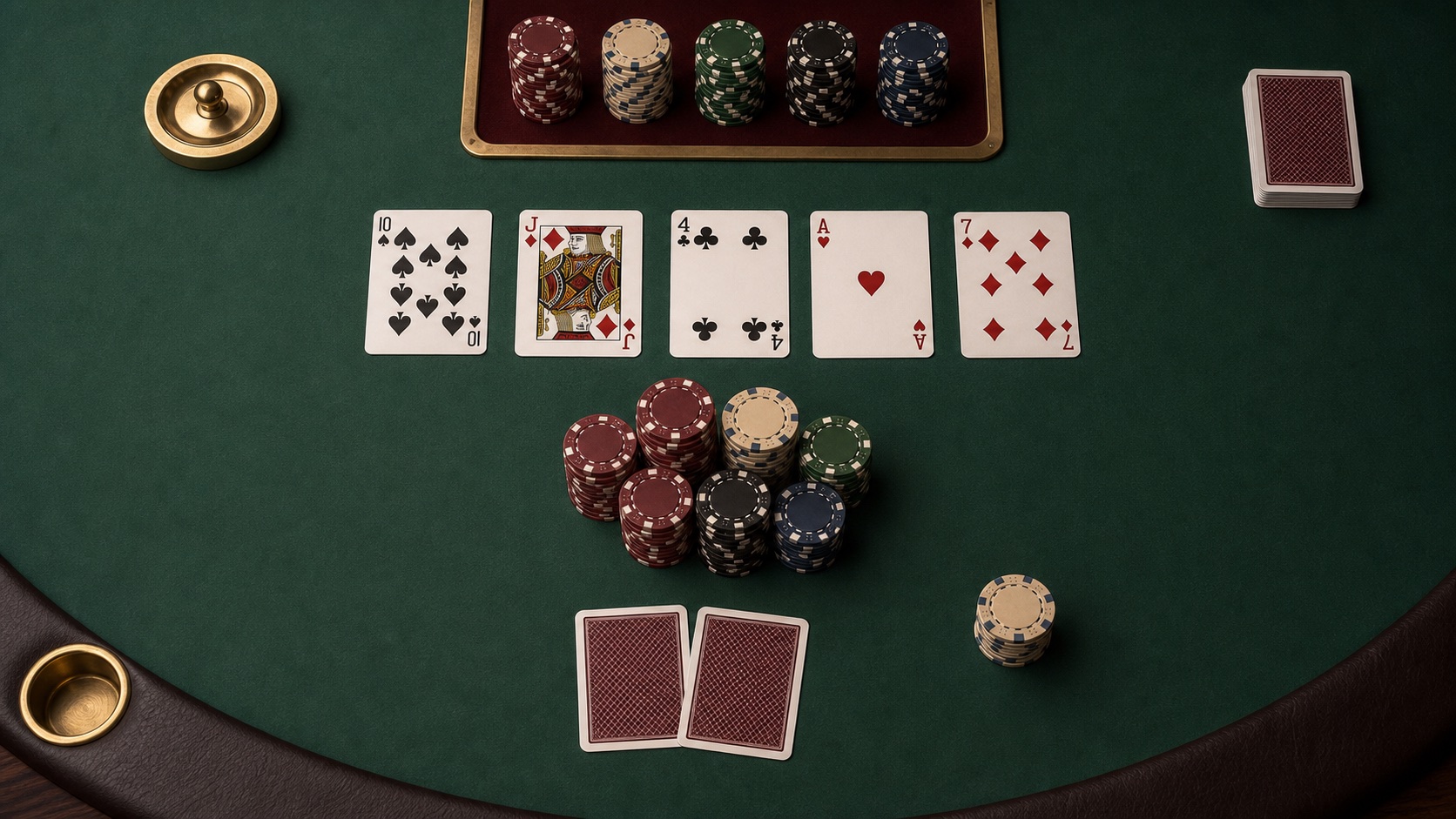
“They could have AA, KK, or an AQ bluff.”
Three options. You beat one. Does that mean you win one-third of the time?
Not necessarily. Three hand labels do not mean three equal probabilities.
AA can contain six distinct holdings. AQ can contain more than a dozen. More importantly, your opponent may not reach this decision and bet with all of them equally often.
Counting combinations turns a vague “they could have it” into specific hands you can check.
Count the cards. Consider how they get played. Then compare the range with the price.
1. A Combo Is Two Specific Cards
AA is a hand class. A♠ A♥ is one combination; A♦ A♣ is another.
Order does not matter. A♠ A♥ and A♥ A♠ are the same holding.
Choose two cards from a standard 52-card deck, without counting reversed orders twice:
52 × 51 ÷ 2 = 1,326 starting-hand combinations.
The familiar 169-cell starting-hand chart groups those combinations into 169 classes. It does not make every cell equally likely.
Start with four numbers: six combinations per pocket pair; for any two different ranks, four suited, twelve offsuit, and sixteen total combinations. These are baseline counts before relevant cards are known. The PokerCoaching combinations reference uses the same basic counts.
2. Where Do 6, 4, 12, and 16 Come From?
Pocket pairs: why six combinations of AA?
Four aces can be paired in just six distinct ways:
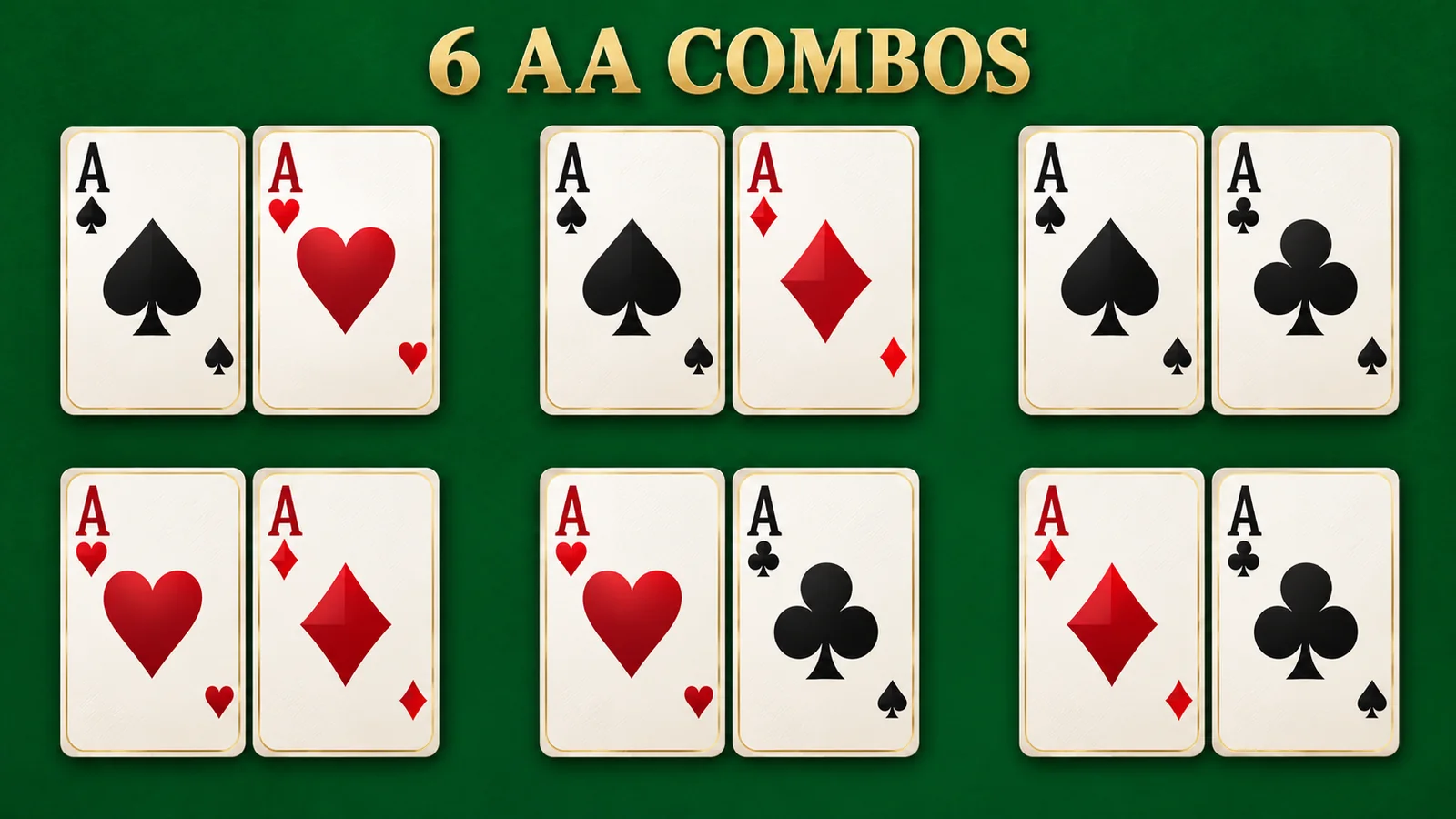
There are four choices for the first ace and three for the second. That gives twelve ordered selections, but every pair appears twice. So:
4 × 3 ÷ 2 = 6. The same reasoning applies to KK, QQ, and every other pocket pair.
Suited hands: why four combinations of AKs?
They are A♠ K♠, A♥ K♥, A♦ K♦, and A♣ K♣. One per suit, four in total. The s stands for suited.
Offsuit hands: why twelve combinations of AKo?
Each ace can pair with three kings of a different suit. A♠, for example, can go with K♥, K♦, or K♣. Four aces, three choices each:
4 × 3 = 12. The o stands for offsuit.
If we write AK without restricting the suits, each ace can pair with any of four kings: 4 × 4 = 16, or four AKs plus twelve AKo combinations.
There is no division by two here. We consistently choose an ace first and a king second, rather than counting the same selection again as king-ace.
3. Known Cards Change the Count
Your cards, the board, and any other cards genuinely known to be unavailable to the opponent must be removed. This is where blockers begin.
For a pocket pair, count how many cards of that rank remain.
- Four remain: 4 × 3 ÷ 2 = 6 combos.
- Three remain: 3 × 2 ÷ 2 = 3 combos.
- Two remain: 2 × 1 ÷ 2 = 1 combo.
- One or none remain: 0 combos.
With K♠ K♥ on the board, the opponent has only one possible KK holding: K♦ K♣. Not six.
For two different ranks without a suit restriction, multiply the remaining counts.
Suppose A♠ and K♥ are known to be unavailable. Three aces and three kings remain, giving 3 × 3 = 9 AK combinations.
Do not divide nine by four to estimate AKs. Spades are missing their ace, and hearts their king. Only A♦ K♦ and A♣ K♣ survive as suited combinations. That leaves 9 − 2 = 7 AKo combos.
Count suited hands suit by suit, checking that both cards remain. And avoid overlapping totals: AK already includes AKs and AKo. You cannot add four AKs to sixteen AK and call it twenty.
4. Turn AA, KK, and AQ Into a Range
Consider a simplified river exercise, not an actual hand history:
- Your hand: Q♥ J♥.
- Board: J♣ 9♦ 6♠ 3♥ 2♣.
- Assume the opponent bets only AA, KK, and AQ, with AQ including suited and offsuit hands.
This is a range chosen to teach the calculation, not a claim about what a real opponent must hold.
Your pair of jacks loses to AA and KK, but beats AQ's ace-high. Count each class:
- AA: no known aces removed, so 6 combos.
- KK: no known kings removed, so 6 combos.
- AQ: four aces remain, but your Q♥ leaves three queens, so 4 × 3 = 12 combos.
If every available combination has the same weight for reaching this point and making this bet:
12 winning combos ÷ (6 + 6 + 12) total combos = 12 ÷ 24 = 50%.
Beating one of three labels does not make this a one-third chance. What matters is the combinations behind those labels.
5. Can You Call With 50%? Check the Price.
Continue the exercise. This is a heads-up river with no rake or ties. Compare calling with folding only, without a raise option. All amounts are demonstration points:
- The pot before the bet is 100.
- The opponent bets 200, twice the pot.
- There is now 100 + 200 = 300 available, and you must call 200.
- After your call, the final pot would be 300 + 200 = 500.
You contribute 200 to contest a final pot of 500. With no ties in this exercise, equity equals the probability of winning. The minimum required is:
200 ÷ 500 = 0.4 = 40%.
Written as pot odds, that is 200 : 300, or 2 : 3. The percentage conversion is 2 ÷ (2 + 3), not 2 ÷ 3. See the full pot-odds walkthrough.
Under the equal-weight range assumption, 50% exceeds 40%, so calling has positive chip expected value. Check it through outcomes: winning adds 300 relative to folding now; losing costs 200.
Call EV = 50% × 300 − 50% × 200 = +50. Expected value is not a prediction of the next result. GTO Wizard's simplified river games also explain decisions through the relationship between equity, betting ranges, and price.
6. Twelve AQ Combos. But Do They All Bet?
Now change one assumption. AA and KK always reach this point and bet, while AQ does so only half as often. Hold the other arrival conditions equal for comparison.
AQ still has twelve physically available combinations, but its weighted combo count in the betting range becomes:
12 × 50% = 6.
You beat a weight of six out of a total weight of 6 + 6 + 6 = 18:
6 ÷ 18 = 1/3, approximately 33.3%.
The price still requires 40%. Under this new assumption:
Call EV = 1/3 × 300 − 2/3 × 200 ≈ −33.3. Folding now beats calling.
Same board. Same hand. Different conclusion. You face the range that actually chooses to bet, not every hand that could physically have been dealt.
“Weighted combos = available combos × relevant action frequency” is a shortcut. Real analysis also needs arrival frequencies through earlier streets, and different suit combinations within one hand class may follow different strategies. A fractional weight does not mean that half a physical hand exists.
Combinations count the possibilities. Action frequencies determine their relative weight.
7. What Changes in Calls, Bluffs, and Value Bets?
Calling: count more than the hands that beat you.
Count the hands you beat, then ask whether they really bet. In our exercise, Q♥ removes AQ combinations. If AQ supplies the bluffs in that model, your queen blocks some of the hands you want to see.
Bluffing: blocking strength is not automatic permission to bet.
Check whether you also remove hands that would have folded, and whether this opponent folds them at all. GTO Wizard's blocker and unblocker discussion examines both sides together.
Value betting: count the worse hands that can continue.
If your cards remove many of the opponent's worse calling hands, “they have plenty to pay me with” deserves another look. Conversely, do not focus on a few combinations that beat you while ignoring the worse calls.
None of these is an automatic action rule. A blocker is evidence for adjusting a range, not a command to call or bluff.
8. Separate What You Count From What You Assume
Keep three distinctions clear:
- Combos are not outs. Combos count possible hole-card holdings. Outs count unseen cards that would give you a winning hand. Merely improving your hand without putting it ahead does not make a card a clean out.
- A combo fraction is not always showdown equity. Our shortcut works on a river where each matchup has a known win or loss and no ties. Earlier streets require future runouts; heads-up ties contribute half the pot.
- Accurate arithmetic does not guarantee an accurate range. Extra value hands, or an opponent who almost never bluffs AQ, can overturn a tidy calculation. Tournament payout pressure, multiway pots, and side pots also require more than this heads-up chip-EV model.
Try a post-session exercise in this order: list a range → remove known cards → count combos → apply action weights → compare the price.
Give the bluff combinations a conservative weight and a higher one. If that change alone reverses the call, the next thing you need may be evidence about the opponent, not another decimal place.
- GTOThe skeleton
- Establish a strategic baseline.
- ExploitThe blade
- Adjust to opponent evidence.
- AwarenessThe spirit
- See what drives your decisions.
Build structure with combinations and price. Calibrate ranges with observed actions. Then notice whether fear makes you count only strong hands, or frustration makes you count every weak hand as a bluff. AI can help check the work; it cannot certify missing evidence.
Counting combos is not about becoming more certain of a guess. It is about making every “they could have it” specific enough to examine.