The Stimulus Loop
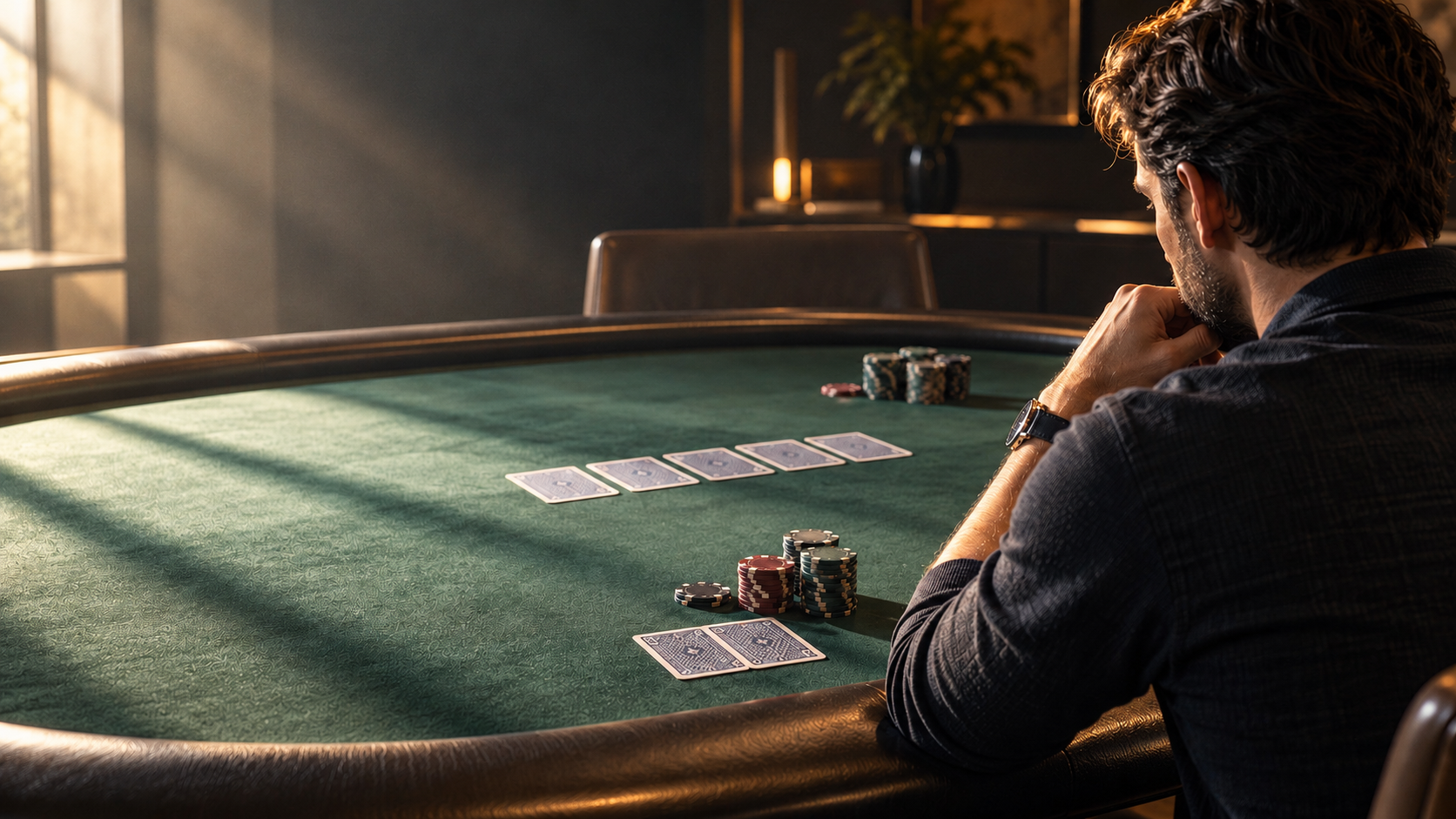
When winning and losing take over attention, another bet can start to feel like a way to ease anxiety, recover losses, or prove oneself.
- 01Stimulus
- 02Stake
- 03Instant feedback
- 04Go again
THE ZENPOKER MANIFESTO
Not to teach people to gamble better, but to help them think better through poker.
We want more people to discover, understand, and participate in poker responsibly, so it can grow into a global decision sport alongside basketball, football, and mind sports.
It is about probability, choice, patience, discipline, and emotion. It is also about how a person meets an uncertain world. You cannot choose the next card, but you can train how you read information, manage risk, and make a responsible choice.
ZenPoker does not operate games, place bets, or decide for the user. We build learning, recording, review, and growth tools so every real hand can become material for seeing strategy, opponents, and oneself more clearly.
When the result cannot be controlled, we can still make the best decision available now.
Risk does not disappear when we change the vocabulary. The real distinction is whether attention is captured by immediate outcomes or returned to information, decisions, boundaries, and review.
When winning and losing take over attention, another bet can start to feel like a way to ease anxiety, recover losses, or prove oneself.
Mature poker practice puts outcomes back in their proper place: results provide feedback, but they do not replace an honest judgment of decision quality.
Poker's most valuable lesson is learning to separate decisions from outcomes. We respect probability and accept variance. Review is not an argument with fate; it asks whether the choice was structured, evidence-based, and responsible given what was known then.
A good outcome does not automatically prove the decision was sound. A bad outcome does not automatically prove it was wrong.
When poker is studied seriously, recorded honestly, and reviewed consistently, it trains more than card skill. It trains judgment under incomplete information and real pressure.
Stop asking one result to explain the world. Learn to understand uncertainty through ranges, frequencies, and long samples.
Keep the strategy and boundaries set in advance, especially when temptation, frustration, or emotion is strongest.
Wait when there is no edge. Do not use action to soothe anxiety, and do not mistake boredom for opportunity.
Understand the exchange between risk and reward while protecting money, time, and the rest of life.
Notice how bad outcomes, losing streaks, and large pots distort action, then recover choice before emotion takes over.
Recognize fear, greed, anger, pride, and the urge to prove oneself instead of disguising them as strategy.
Play the hand in front of you. Release the self that demands a particular result.
Return to the information available now. Do not avenge the last hand, chase a loss, or become careless after a good run. Face reality and make the decision you can responsibly own.
Release the ego that says, “I must win,” “I cannot lose to them,” or “I have to get it back today.” The next card does not change for your identity, emotion, or attachment.
Strength is not controlling the result. It is retaining control of yourself when the result cannot be controlled.
We want Texas Hold'em to be understood as more than a vehicle for casino outcomes. Like basketball, football, chess, and Go, it can be a global competitive activity requiring strategy, discipline, psychology, and long-term practice.
ZenPoker does not run games, operate a gambling platform, or handle player funds. We build learning and review infrastructure: lowering the barrier to understanding, helping new players begin responsibly, and helping experienced players improve decision quality. The more people who understand the game, the healthier and more diverse its ecosystem can become.
Help more people use Texas Hold'em to understand information, respect risk, see themselves clearly, and make higher-quality, more responsible choices under uncertainty.
Help poker cross borders and cultures like basketball, football, and mind sports. When people think of poker, let them think not only of money, but also strategy, probability, discipline, psychology, self-mastery, and growth.
Judge an action not only by the outcome, but by whether it made sense with the information available and over a long sample.
Accept variance, respect probability, and refuse to let one night define ability or personal worth.
Freedom means keeping your principles when impulse is strongest, and remaining able to stop.
See fear, greed, anger, and attachment as information rather than commands.
Winning one hand is an outcome. Becoming a clearer decision-maker is the lasting gain.
The game should serve the person. Training and growth must never excuse lost boundaries or the loss of freedom to leave.
Poker involves wagering, financial risk, and variance. The table can become a place for decision training only while a person can assess risk, protect money and time boundaries, and stop freely.
Begin by recording one real hand. Let AI organize the facts, examine the structure, and surface the evidence while leaving the final decision and responsibility with you.