Structure
GTO · Model · Baseline
Probability, ranges, EV, and GTO provide a repeatable rational baseline. They show where to begin when no extra evidence is available and reduce the influence of impulse.
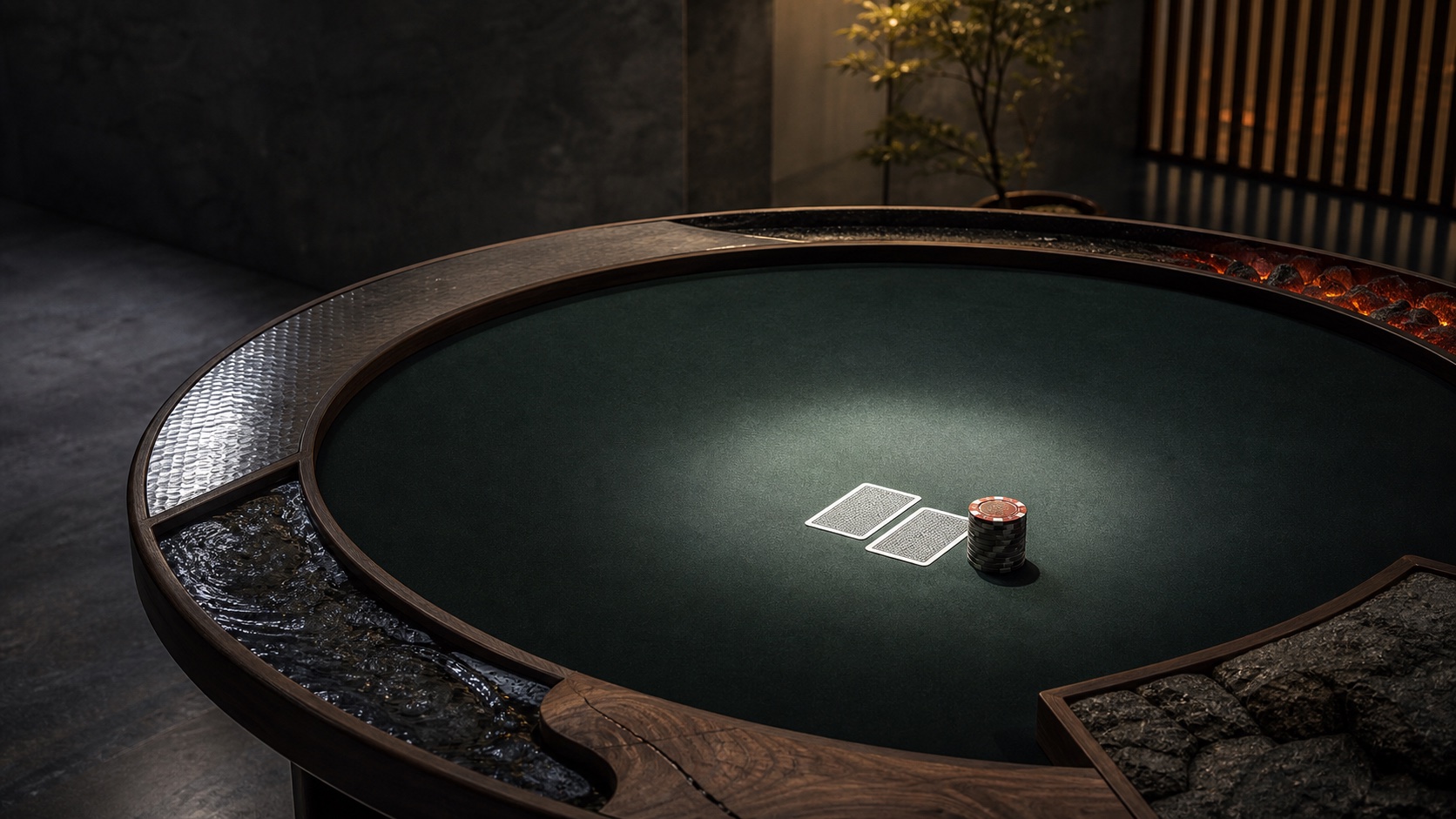
The Way of Clear Decisions
Not a promise to always win, but a practice for seeing reality, keeping boundaries, and choosing responsibly amid uncertainty, incentives, and emotion.
One Way
Two Forces
Three Foundations
Four Directions
Five Capabilities
Six Practices
Every Situation
One direction. Two balancing forces. Three foundations. Four points of orientation. Five trainable capabilities. Six daily practices. One way of acting clearly in every situation.
One · The Way
In ZenPoker, the Way is not a mystical answer. It is a testable direction: outcomes remain volatile, while decisions become clearer, more rational, and more responsible. Winning is not the only measure. Decision quality is the asset that compounds.
See reality in uncertainty. Keep choice under pressure. Continue growing after the result.
Two · Yin and Yang
You do not need to know Chinese cosmology to use this idea. Here, yin and yang are two complementary decision systems: stable structure gives you a baseline, while fluid awareness helps you update from reality.
GTO · Model · Baseline
Probability, ranges, EV, and GTO provide a repeatable rational baseline. They show where to begin when no extra evidence is available and reduce the influence of impulse.
Exploit · Context · Adaptation
Opponents, Fields, stacks, emotions, and time keep changing. Awareness respects live evidence, notices projection, and adjusts without abandoning boundaries.
GTO and exploit are not opposing choices: one prevents self-deception, the other prevents rigidity. Zen helps us know when to hold and when to update.
Three · Three Foundations
Without limits, focus, and reality-based judgment, any technical skill can be recruited by impulse. These are not spiritual decoration. They are the stabilizers beneath decision training.
Decide what is off-limits: no essential living money, no borrowing, no play while impaired, exhausted, or out of control, and always preserve the freedom to leave.
Keep attention on the information and decision in front of you, not the last loss, the next fantasy, or outside stimulation.
Separate outcome from process, label from evidence, and cleverness from truth. Admit uncertainty and notice what you most want to believe.
Four · Decision Compass
The compass does not divide players into four personality types. The four guardians are a Chinese memory layer; Learn, Act, Discipline, and Observe are the universal skills underneath it.
East · Azure Dragon · Wood
Learn & Grow
Move toward what is new: study, record, review, and let every result produce a next step.
South · Vermilion Bird · Fire
Act & Influence
Turn understanding into execution, communicate clearly, and leave the table better through your presence.
West · White Tiger · Metal
Discipline & Structure
Use structure to contain impulse: respect probability, ranges, GTO baselines, and pre-committed limits.
North · Black Tortoise · Water
Observe & Adapt
Observe before judging: read opponents, the Field, and your own emotion, then update with evidence.
The center is not a fifth direction. It is the ground that holds all four, integrating growth, action, discipline, and awareness with bankroll, time, responsibility, and life.
The four directions provide orientation. Earth turns orientation into a system.
Five · Five Capabilities
Metal, water, wood, fire, and earth are not personality types or fixed playing styles. They describe five capabilities within a decision system, each generating and balancing the others.
Metal
Use probability, ranges, and evidence to keep desire from replacing facts.
Practice: odds, EV, ranges, and GTO
Water
Observe opponents and yourself, update with new evidence, and resist premature labels.
Practice: emotion, Field, and behavior
Wood
Turn wins and losses into feedback, and every review into a next action.
Practice: records, review, and deliberate work
Fire
Organize understanding into strategy, then execute it when pressure becomes real.
Practice: strategy, rhythm, and discipline
Earth
Hold variance, responsibility, and limits so skill, mindset, and life remain aligned.
Practice: bankroll, time, and the long term
Logic clarifies observation; awareness creates honest growth; growth becomes executable structure; action settles into stable capability; stability makes judgment more precise. The five elements are a cycle, not a ranking.
Six · Six Practices
The six paramitas require no religious background. They can be understood as six observable behaviors that can be reviewed and trained.
Share knowledge, respect staff, and give newcomers psychological safety. Leave the table better because you were there.
Keep bankroll, time, and conduct limits when temptation is strongest, turning impulse back into choice.
Hold bad beats, mockery, and losing stretches. Emotion may arise, but it does not own the next decision.
Record, review, and verify consistently. Do not confuse playing longer with practicing better.
Begin every hand again. Return attention to the board, actions, stacks, and breath.
See the game, the opponent, and yourself as they are. Understanding is not control; exploiting is not contempt.
Everywhere · Practice in Every Hand
A philosophy must return to product and action. ZenPoker brings the whole system into a repeatable four-step loop.
Set bankroll, time, and emotional limits. Become quiet for a moment and choose one training theme.
Record facts and the thought behind each action: what did I see, what did I fear, and why did I bet?
Review both technique and mind: ranges, sizing, EV, as well as greed, fear, anger, and the need to prove yourself.
Give thanks, share, admit mistakes, release results, and do not carry table emotion into your relationships.
Poker includes betting, risk, and variance. ZenPoker does not deny addiction or romanticize casinos. A table can become a place to train awareness and decisions only while a person can assess risk honestly, keep limits, and leave freely.
When you lose the ability to stop, it is no longer practice. It is a constraint. The right action is to limit, pause, leave, and seek real help.
Result · Decision Quality
From the Way and balance to the three foundations, four directions, five capabilities, and six practices, everything points to one result: knowing what a better decision is, and being able to make it when pressure becomes real.
GTO shows us what is sound. Exploit helps us understand people. Zen preserves our freedom to choose amid greed and fear.
See the game. See the opponent. See yourself.