Someone watched my play and said:
"I can see fear in your play."
I thought I was respecting opponents and controlling risk. But reviewing a few folds, I began to ask: am I assessing what he can have, or imagining how much losing would hurt?
In the previous article, I was afraid a raise would scare everyone off. This time, when an opponent applied pressure, I wanted out.
Based on real hands, presented in demonstration points. Opponents are identified by position.
AQ: One Raise, and All I See Is Strength
Eight-handed, with blinds of 5/10, I held A♠ Q♥ in UTG1. I 3-bet to 400 and three players called.
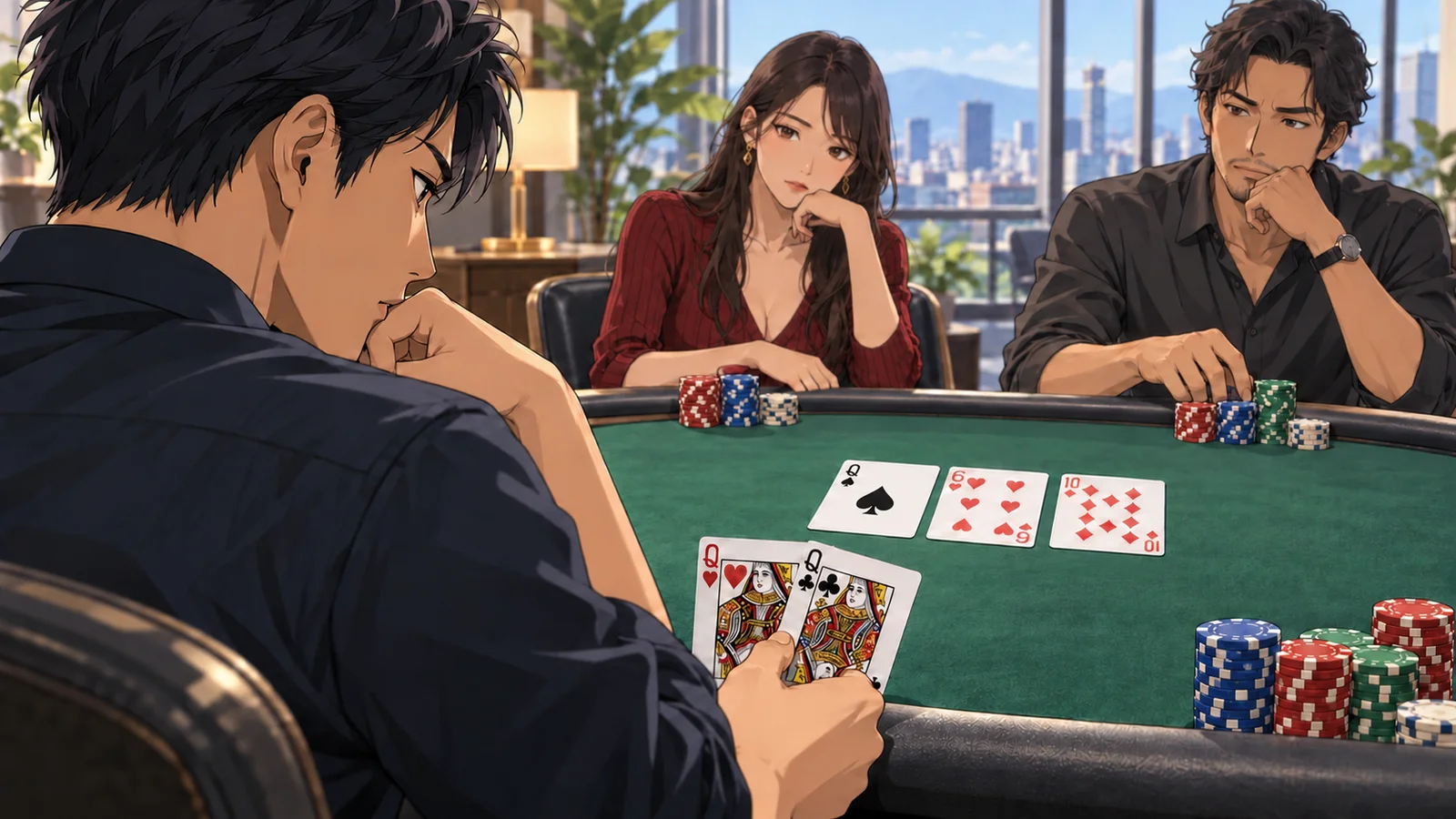
On 8♠ 6♣ Q♣, I bet 800. The button raised to 1,800. The other two players folded. So did I.
A raise in a four-way pot deserves respect. But I needed 1,000 more to contest a final pot of about 5,210 if I called: a direct pot-odds threshold of roughly 19.2%.
That is not an automatic call. Two streets remained, and his range could be strong. But had I seriously considered club draws, semi-bluffs, and any worse made hands this particular player might raise?
His cards were later recorded as A♣ J♣. That is not a hindsight argument for calling. It is a reminder: the worst possibility is not the only possibility.
JJ: One More Player, One More Thing That Could Go Wrong
I held J♥ J♣ in the lojack. UTG opened to 120, I 3-bet to 400, and the cutoff cold-called. UTG shoved to 3,300. I folded, then the cutoff folded too.
My note was clear: I would have called heads-up. It was the cold-caller behind me that stopped me.
A third player changes things. He might be trapping with a bigger pair, or might call the shove. But he also adds chips. Lower equity does not necessarily mean lower expected value (EV).
The decision depends on UTG's shoving range, the cutoff's cold-calling and continuing ranges, and possible side pots. Against a very tight UTG range, folding JJ can be entirely reasonable.
What I need to examine is whether I weighed those factors, or simply wanted to eliminate one more possible upset.
QQ: Wide Enough to Raise Against, Suddenly Only AA or KK
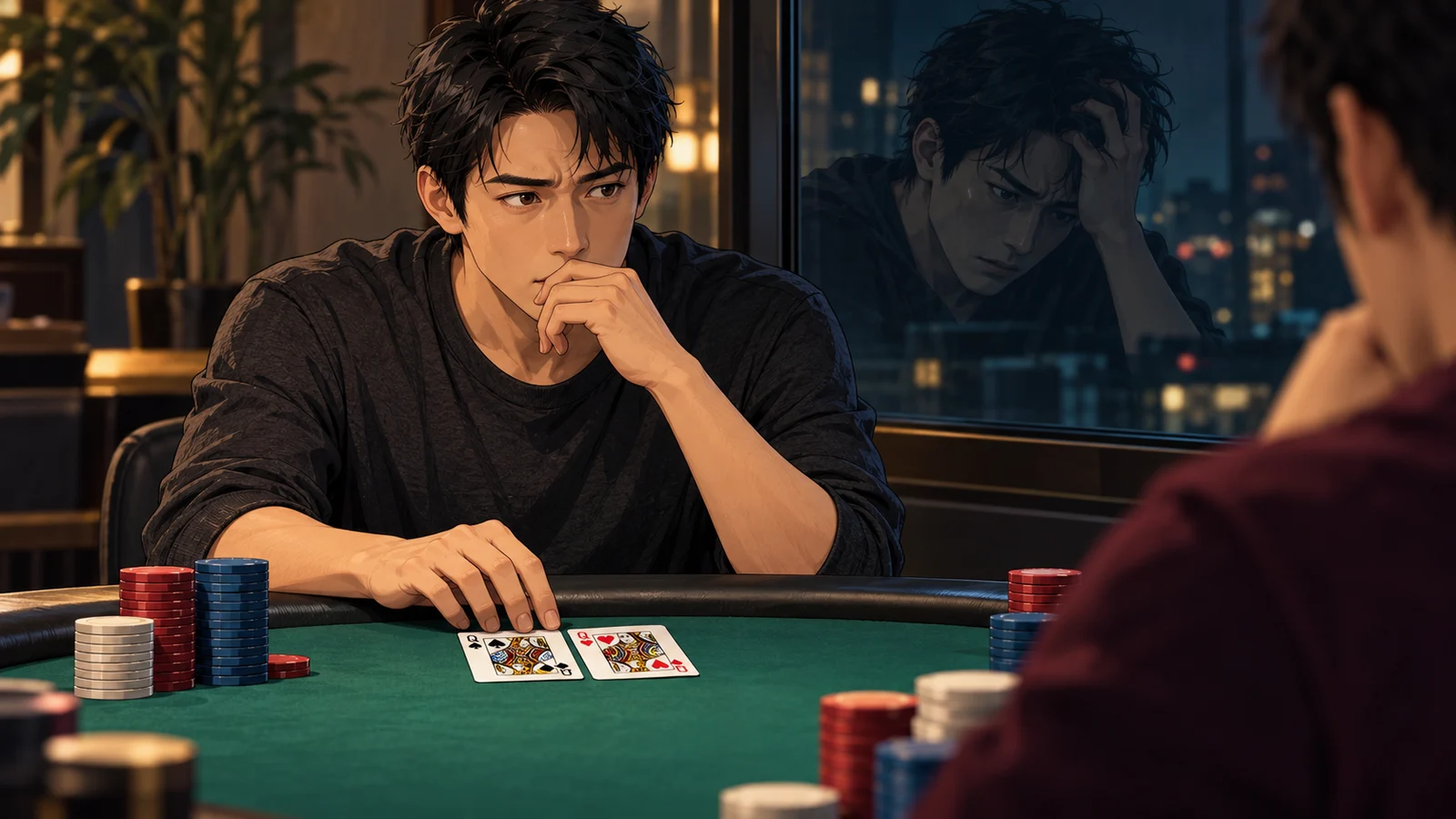
I held Q♠ Q♥ in the hijack with an effective stack of 11,000. After two limps, I raised to 200. Three players called, then UTG1 limp-reraised to 1,200. I 4-bet to 2,800.
The others folded. UTG1 shoved. I folded.
I needed 8,200 more to contest an effective final pot of 22,605, a threshold of roughly 36.3%. Against almost exclusively AA and KK, folding makes sense. Enough AK, smaller pairs, or bluffs could change the answer.
His cards were later recorded as 6♥ 7♦. That does not prove QQ had to call. The useful question is:
Between my raise and his shove, what new evidence appeared? Or did the possible loss simply get bigger?
A shove is new information. Ranges should change. But if I previously believed he could apply pressure with a wide range, those possibilities should not disappear without examination.
Fear Can Sound Like Analysis
"Be careful in multiway pots."
"You cannot casually stack off this deep."
"He cannot be bluffing every time."
Any of those statements can be right. Have I connected it to this opponent, this size, and this decision?
Fear's most subtle effect is not stopping thought. It is making thought serve only the worst-case outcome.
I may still be analyzing, but count only hands that beat me. I see the possible loss and stop comparing cost with return. "Which decision makes sense?" becomes "How can I avoid feeling bad?"
The opposite reaction is no better: calling just to prove I am not afraid. A fold is not proof of fear. A call is not proof of reason.
Not Braver. More Honest About the Evidence.
The next time I face a big action, I want to answer three questions:
- What are his value hands, and what evidence supports weaker hands or bluffs?
- What does this price require, and what risks remain?
- Am I changing my assessment because of new information, or fear of the result?
Chips already invested do not oblige me to continue. Cards revealed afterward cannot make the earlier decision for me.
If the risk exceeds my preset limits, the responsible response is to pause, leave, or choose a lower-stakes game. I do not need a call to prove anything.
- GTOThe skeleton
- Establish a strategic baseline.
- ExploitThe blade
- Adjust to opponent evidence.
- AwarenessThe spirit
- See what drives your decisions.
Game theory optimal (GTO) thinking gives us a baseline. Ranges and pot odds provide structure, opponent evidence guides adjustments, and Awareness asks whether we have quietly rewritten the evidence.
Play the hand, drop yourself.
What needs letting go is not only the ego that wants to win, impress, or prove a point. It is also the self that insists: "I cannot lose this hand."
Reason is not the absence of fear. It is refusing to rewrite the evidence when fear arrives.