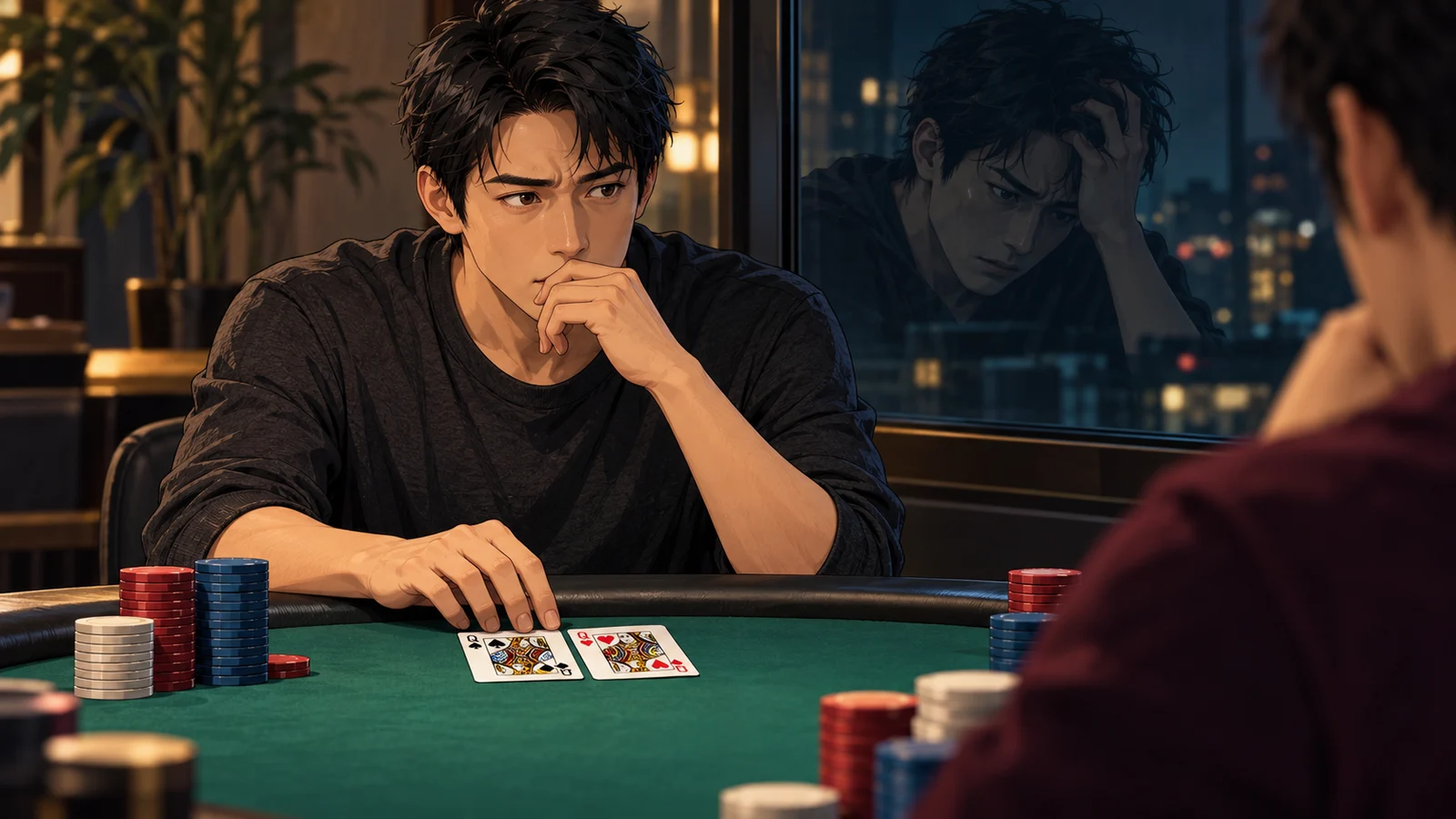
If I stop playing poker one day, what would I hope to take with me?
Memorable hands, a more practiced strategy, perhaps a more concrete understanding of probability. But something else would matter more: knowing what is driving me, and being able to choose again once I see it.
When am I making an assessment, and when am I afraid? When am I pursuing a reasonable opportunity, and when am I trying to prove something?
That is why I find value in approaching Texas Hold'em as one way to know myself.
A hand makes the questions specific. How do I decide under uncertainty? When the outcome disappoints me, how do I treat myself, the opponent, and the next choice?
1. Knowing Your Principles Is Different from Knowing Your Reactions
Without pressure, many principles are easy to endorse.
“I respect probability.” “I do not need anyone's approval.” “I know when to stop.”
Then a strong hand gets outdrawn. The same opponent wins another pot. The planned finishing time arrives while the session is still down.
Those principles acquire a cost.
We may decide that today's loss has to be settled today. Or we may find too few plausible bluffs and still want to call, simply to show an opponent that we cannot be pushed around.
We often know the ideas we agree with better than we know what we actually do under pressure.
A decision at the table can reveal the distance between the two.
One call does not define a person, though. One loss of control does not establish an immutable character trait. Fatigue, the amount at risk, and missing information may all matter. The useful subject is a reaction that recurs under identifiable conditions, rather than a label attached to the whole person.
2. Desire, Loss, and Uncertainty Come into View
Poker can make several inner tensions easier to observe.
How do I respond to wanting more?
The plan was to play for two hours. After winning, leaving feels wasteful. A larger stack has loosened a boundary. What reason would justify changing the plan, and has that reason been examined?
How do I respond to a loss I resent?
The loss has already happened, but the next hand receives an extra assignment: recover the previous pot. A fresh decision becomes responsible for repairing the past. An opponent becomes someone I must beat rather than someone whose actions I need to understand.
How do I respond to not knowing?
Sometimes a call has sufficient support from ranges and price. Sometimes I simply cannot bear wondering whether the opponent had it. An expensive attempt to end uncertainty can feel like courage.
Traditional terms such as greed, anger, and delusion can help describe these reactions without becoming moral verdicts. A more useful question is: what am I trying to obtain, and what am I trying to avoid?
These questions can also be explored in everyday life. A pattern noticed at the table is a clue, however, rather than proof that we behave identically at work, in relationships, or in another setting involving risk.
3. Finding Room to Choose After an Emotion Appears
Imagine getting all-in before the flop with AA and losing to a much weaker starting hand.
The first thought might be anger: “How does that hand win?”
Then another thought arrives: “Now I know how he plays. I will get him next hand.”
The first thought reacts to an outcome. The second is already planning an action. Without attention, almost no space separates them.
Awareness can begin there: noticing that I am still angry, that I especially want to target one person, and that separating the previous hand from the next is difficult right now.
Once I notice, the action can change. I can pause participation and step away from the screen or table. When I can examine the facts, I can review effective stacks, actions, and all-in ranges. AA getting outdrawn is not enough information to evaluate the strategy.
I may also find that continuing today is inappropriate. Then the practice ends there.
A boundary can take effect while the emotion is still present.
Progress may be as small as remaining angry without making the next hand pay for it.
4. Letting Go While Accepting the Consequences
“Do not worry so much about results” is easily misused.
If it leads someone to stop recording losses, avoid examining long-term performance, or describe money lost as the price of spiritual growth, it is weakening their judgment.
For me, letting go means looking at several responsibilities separately.
Evaluate a decision using the information available at the time. A poor choice can succeed, and a reasonable choice can lose. Long-term records offer evidence, but still require attention to sample size, changing conditions, and individual decisions.
Acknowledge the real cost. An insight does not cancel a financial loss. Money, time, sleep, and effects on other people still count.
Give one outcome an appropriate place in your view of yourself. Losing today does not establish that you are worthless. Winning does not exempt the next decision from scrutiny.
We can limit losses, correct a technical mistake, and allow ourselves to feel disappointed at the same time.
Freedom becomes observable here: being able to finish within a planned boundary without recovering the loss, or to revise an assessment without first proving our ability.
5. Self-Knowledge Needs Something You Can Check
“I finally understand myself” can become another comforting story.
Calling every fold fear can obscure sound strategic reasons. Calling every aggressive move courage can conceal impulsiveness. Even “I am training my mind” can become an excuse to keep playing.
Looking inward therefore needs an external check.
A review after the hand can bring three layers together:
- Facts: What were the positions, effective stacks, board, and actions? What information is missing?
- Assessment: What do ranges, price, and a strategic baseline support? Which observed opponent behaviors justify an adjustment, and how much evidence is there?
- Reaction: What did I most want to avoid or prove? Did that thought change my choice?
“I was afraid of losing” records an internal experience. “Therefore the fold was wrong” is a separate conclusion that needs verification. The analysis between them still matters.
- GTOThe skeleton
- Establish a strategic baseline.
- ExploitThe blade
- Adjust to opponent evidence.
- AwarenessThe spirit
- See what drives your decisions.
GTO provides the skeleton: a strategic baseline. Exploitation provides the blade: adjustments grounded in opponent evidence. Awareness gives the practice its depth: seeing how we use or distort that information. Together, they should lead to one change we can verify.
After a hand, AI can help organize actions, check assumptions, and compare recurring patterns in records. It can also misread information or offer an unsupported psychological explanation. You can ask for its evidence, require it to acknowledge uncertainty, and correct its assessment.
Conclusions about yourself still need to be checked against your own experience.
6. Life Is Where the Learning Has to Hold Up
If a form of “growth” depends on continuing to play, it deserves another question.
After noticing resentment, can I stop a pointless argument? After acknowledging uncertainty, can I verify another fact before an important decision? After recognizing fatigue, can I rest instead of proving that I can keep going?
Playing poker does not make these changes happen automatically. They need practice away from the table.
There are many ways to know yourself: exercise, writing, work, close relationships, or quietly reviewing a day's choices. Self-knowledge does not require taking financial risks. Old hand histories, practice without monetary wagering, and offline review can provide material for reflection.
If participation is affecting essential living funds, involves borrowing, or cannot be stopped as planned, stop participating and seek support from someone you trust or a professional. Restoring choice in everyday life takes priority.
This path also permits an ending. If poker eventually leaves your life, honesty, patience, and a sense of boundaries can remain.
7. Begin with One Honest Record
There is no need to play another session after reading this.
Choose an old hand that stirred a strong reaction. Temporarily hide the result and complete one record:
What I most wanted to avoid or prove was …. The facts supporting my decision were …. When that thought appears again, I will first ….
Make the last entry an observable action. For example: when “I must win it back” appears, end participation in that session and review offline later.
When a similar moment occurs, check whether the action happened. If it did not, record the conditions honestly and adjust the boundaries and arrangements. Adding self-blame does not make the record more accurate.
Perhaps this is part of the pleasure of knowing yourself: finally describing a reaction that used to repeat unnoticed, and preparing a different choice.
A deck of cards can offer a way to know yourself. Carry what you learn back into life, toward the people and responsibilities you value.
Let poker open a path, while keeping the freedom to leave it.