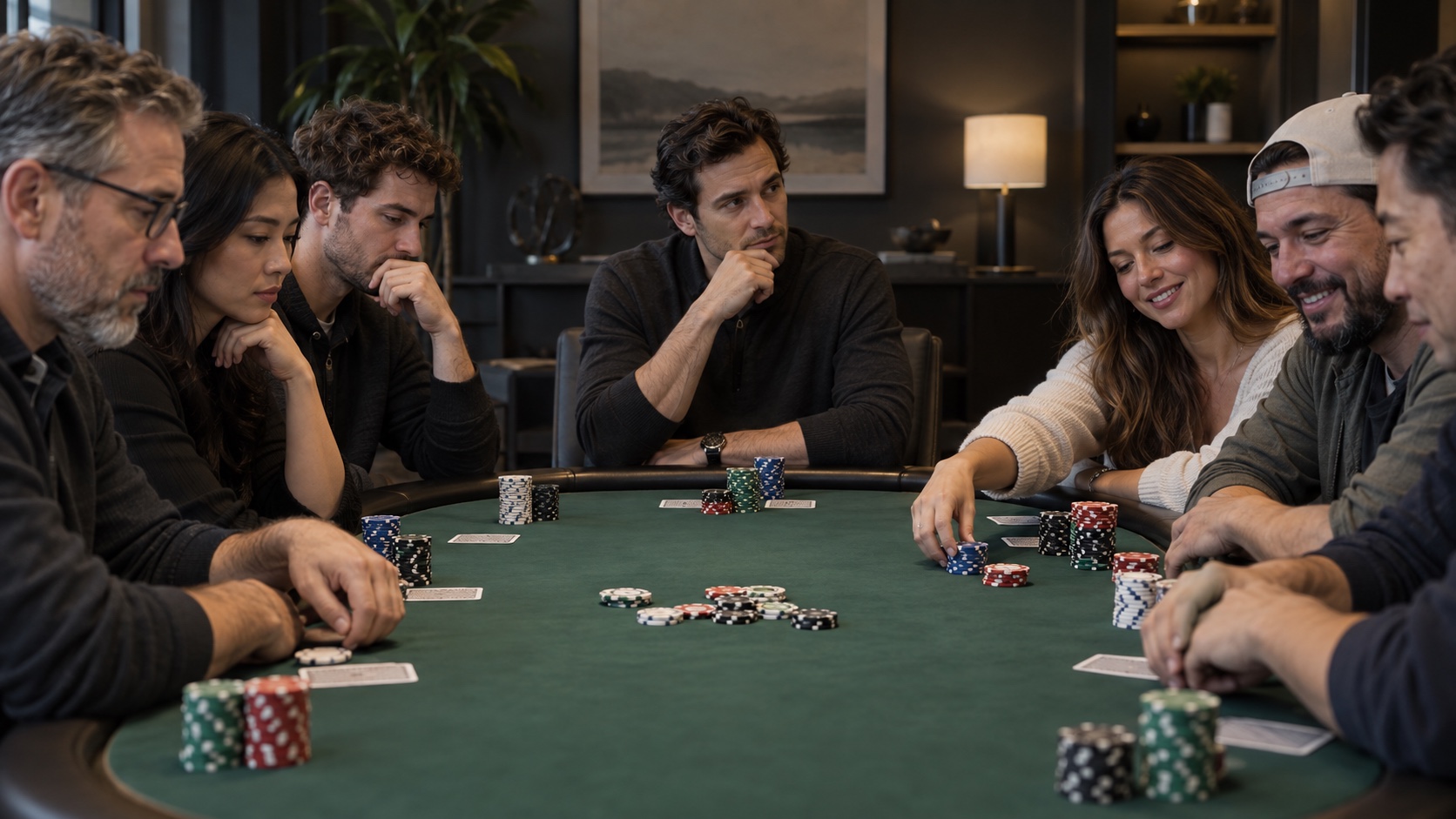
If you can't spot the sucker in your first half hour at the table, then you are the sucker.
Opening voice-over, Rounders (1998). Screenplay source
It's a great line. It also comes with side effects.
Some viewers learned to observe the table. Others accidentally enrolled in a second career: Director of Aquatic Research.
Who's entering every pot? Who hates folding? Who just showed up with a hand that looks like a misclick? Open a file. Keep them under surveillance.
Table selection itself is reasonable. Choosing a game that fits your skill, bankroll and time limits is judgment, not cowardice. You don't owe anyone a demonstration of bravery at an unsuitable table.
The trouble starts when selection becomes an entitlement: there's a weaker player here, so I should win, preferably before the next break.
The movie told you to spot the fish. It did not promise to supervise your decisions afterward.
Here, “fish” is poker slang for decision leaks or a temporary loss of judgment, not a permanent identity. Experience does not grant immunity. And someone who came to enjoy a game does not owe you a supporting role in your success story.
The real test in a recreational game often isn't how good your best poker is. It's whether looking down on your opponents turns you into the fish.
1. You Came to Find a Fish. You Found a Second Job.
Picture a fictional scene, not an actual hand history.
You're waiting patiently, respecting position, picking your spots. A recreational player beside you enters pots with hands you would fold, then keeps making odd two pair and unexpected straights. You're still evaluating the opportunity. They're already stacking the result.
At first, it just stings.
Then your internal commentator wakes up: “If that works, what was all my studying for?”
Soon the commentary becomes a deadline: “They'd better not leave before I get a hand against them.”
Now your entry range gets wider. Position starts losing arguments to pride. Isolation raises feel personal. River calls start looking like formal complaints.
You think you're waiting for an edge. You're actually trying to hit a quota.
The first bad result might have been variance. The loose calls, forced pots and refusal to fold afterward might be genuine mistakes. Mix them together and the session gets one convenient explanation: “The fish ran hot.”
Maybe they did. Variance still shouldn't have to cover every shift.
2. Variance Doesn't Check Your Résumé
“I understand more than this player” might be true.
“Therefore I should win this hand” is not part of the benefits package.
A wide range can make strong hands on strange boards. But covering more boards is not the same as having a stronger overall range. The missed flops, dominated pairs and poorly priced draws are less memorable than one outrageous river. Your memory is not an impartial bookkeeper.
The reverse matters too. Not every loss by an experienced player belongs in the bad-luck folder. Professional status does not make an error deductible. Whether you have an edge still needs evidence.
You can study for years and lose a hand, or a session, to someone who just learned the rules. Short-term results do not protect anyone's credentials.
A skill edge is not a property claim on someone else's chips.
Nor is a long-run advantage a same-night delivery guarantee.
If you're already listing their stack as an account receivable, your ego has hired an accountant.
3. A Loose Range Is Not a License to Pay
“They play loose” is a clue. It is not an all-access pass.
One player wants to see every flop but raises rivers only with very strong hands. Another gets creative in small pots and suddenly discovers religion in big ones. A third really does fire multiple streets with air.
All three may get the same nickname. They should not get the same response.
A wide preflop range does not imply a wide river raising range.
Take this fictional, simplified example. You hold A♠ K♣. The board runs K♦ 8♣ 3♥, then 6♠, then 4♦. You still have one pair. Your opponent makes a large river raise and eventually shows 7♣ 5♦ for a straight.
Your first thought might be: “How did that hand even get here?”
The more useful question, before seeing the cards, is: what hands take this line at this size, and how many are value hands versus bluffs?
The example does not establish that you should always fold. Sizing, previous actions and actual evidence matter. Some bluff-catches remain sound decisions even when they lose.
It establishes only that one adjective cannot do the work of street-by-street range analysis.
“They're a fish” is not a complete hand-reading model.
4. You Criticized the Draw. Then You Picked Up the Tab.
There is a particularly awkward partnership in poker. Neither party remembers signing up.
Your opponent chases at an unattractive immediate price. You're delighted: “Keep calling. This is educational.”
Then the board changes, their action gets much stronger, and you pay without a good reason because you refuse to believe they got there again.
You started by inspecting their mistake. You ended by financing the sequel.

This is where implied odds, the extra payment a player may receive after completing a hand, matter. If you consistently overpay when the draw arrives, an apparently expensive earlier call may look different when the whole line is counted.
Separate the questions:
- When I bet, was their price to continue attractive?
- Once the board and ranges changed, was my payment justified?
This is not a new commandment to fold whenever a scary card appears. An opponent with enough bluffs can justify calling. Don't replace unconditional payment with unconditional belief.
Accepting that a draw can hit does not mean providing unlimited after-sales support.
The aim isn't to dodge every losing outcome. It's to stop paying the extra bill whose only justification is “Surely not them again.”
5. Exploit a Tendency, Not a Nickname
There is no universal menu labeled “Beat Recreational Players.” Start with behavior.
If they call too widely but rarely raise:
Identify which worse hands will actually continue. Value ranges and sizes can adjust to that evidence. “They're recreational” is not, by itself, a reason to bet enormous amounts.
If they really do keep attacking with air:
Keeping their bluffs in can be better than immediately driving them out. Defend with appropriate hands and repeated evidence, not a facial expression that apparently says “likes bluffing.”
If they're wild in small pots and honest in big ones:
Preserve that distinction. Frequent early participation does not cancel a strong later signal.
If pots are routinely multiway:
Reconsider one-pair strength, bluffing conditions, nut potential and position. A heads-up play does not receive an automatic multiway renewal.
Deep stacks make these distinctions more important. “They'll pay” and “Which hands should I use to pursue that value?” are separate questions. Being out of position with an easily dominated holding doesn't become safe just because another player has leaks.
GTO, an equilibrium-strategy baseline within a specified model, can provide structure. Exploitative adjustments need evidence of actual deviations.
Let the baseline support your judgment and the evidence guide the adjustment. Don't let your ego size the raise.
6. They Don't Have to Leave Before You Can
The dangerous sentence often isn't an insult. It's a schedule:
“I have to get it back before they leave.”
That is not a strategy. It's software with the exit button removed.
The long run includes tolerable variance, bankroll and time boundaries, rake, and an honest assessment of your ability. Positive expected value requires assumptions that hold. It is not generated by saying “long term” over a chip stack.
Long-term thinking doesn't mean tonight owes you a refund. It means refusing to change today's decision standards just to recover a result.
When you notice the urgency, the personal targeting or the need for an explanation, pause. Water, a break or ending the session are complete options. Essential living funds, borrowing or an inability to stop put stopping ahead of any tactical discussion.

You needn't wait for the recreational player to leave before giving yourself permission to rest. And you needn't pass an “I'm definitely over it now” test to justify remaining at the table.
Sometimes the most obvious leak is knowing you should stop, then looking for one more hand to repair your mood.
7. Release the Grievance, Not Another Stack
Try one small action in your next review: find the hand in which you most wanted to teach someone a lesson. Hide their name and the word “fish.” Then rewrite the actual reason for your action.
If the reason concerns position, ranges, sizing and repeatedly observed behavior, examine it.
If the reason disappears when the nickname does, you've found something worth working on.
This is a useful role for ZenPoker as a mirror: not announcing who deserves to lose, but helping distinguish a decision based on evidence from one made by wounded pride.
Respecting a recreational player doesn't require endorsing every play. Respecting your own experience doesn't require immediate obedience from the deck.
Choose games thoughtfully. Take decisions seriously. Just don't turn every pot into a press conference about how good you are.
The famous movie line could use a footnote:
After you've spotted the fish, check the mirror occasionally.
Otherwise, you may spend the whole session holding the rod without noticing you're also wearing the hook.
Illustrations are original AI-assisted editorial cartoons, not film stills. The hand example is fictional and does not identify a real player. Nothing here promises returns or a winning percentage.