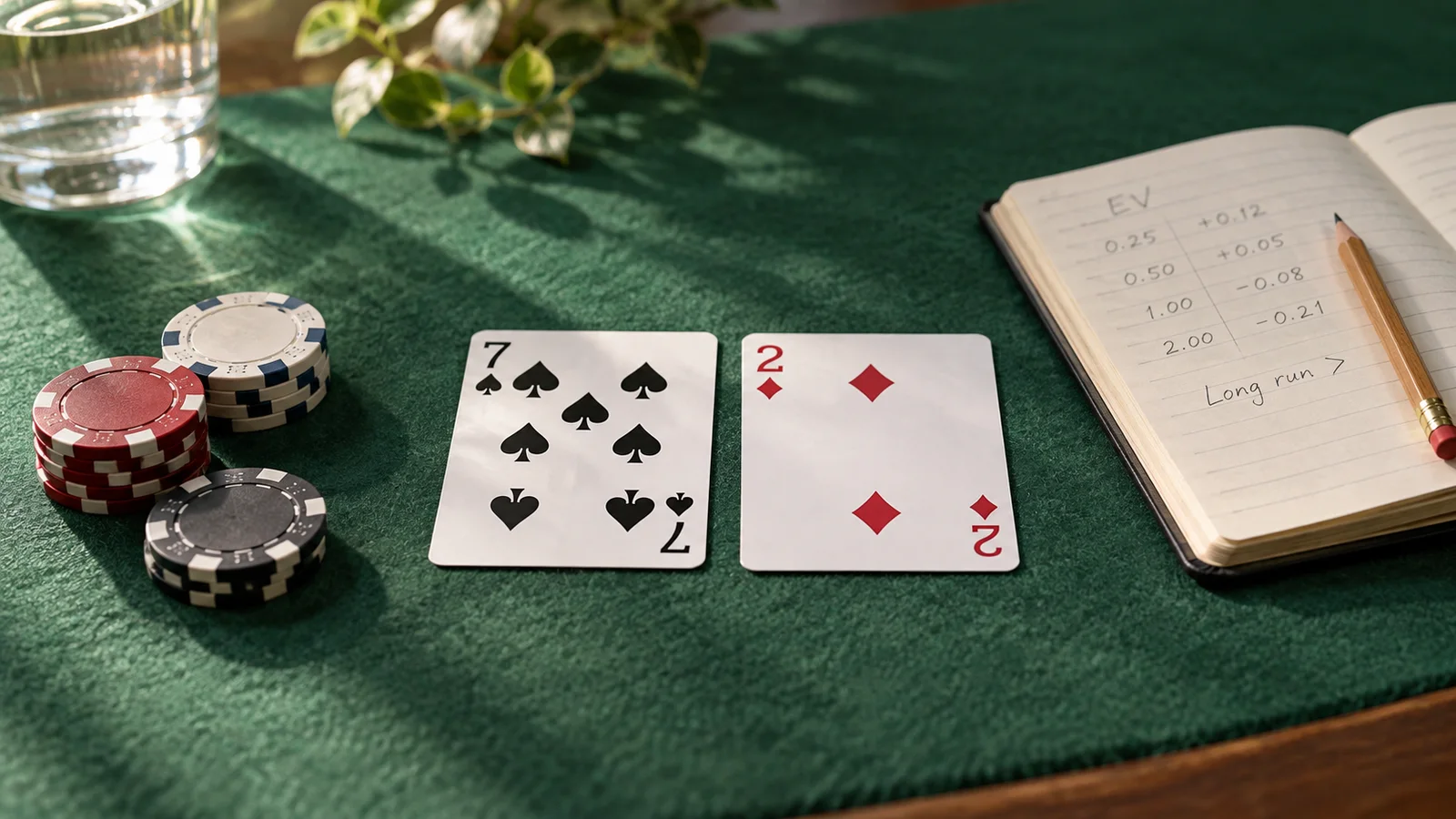
I used to love playing seven-deuce.
Not because it was a good hand. Because winning with it felt so good.
Win a pot with aces, and nobody is surprised. Bluff someone off a hand with 7-2, turn your cards over slowly, and the whole table changes. People laugh, complain, and reach for your bonus.
You collect more than money. You collect everyone's attention, along with an unspoken message:
"I made you fold with the worst hand at the table."
Eventually, though, I started wondering: did those memorable wins actually make me money?
72 Bonus: The Money Is Only Part of It
Some cash games offer a seven-deuce bonus: win a pot with 7-2 under the agreed rules, and the other players owe you an additional payment.
The amounts I am discussing are not extravagant, several-thousand-dollar bounties. Think RMB 500 per player in some Chinese games, or $100 per player in some American games, occasionally $200. These are examples, not a universal standard; the table's agreement matters.
Under some Squid Game variants, winning with 7-2 also lets you take another player's token, perhaps even the most valuable one. The details vary. The intention is straightforward: get people to play a bad hand and generate more action.
But the money may not be the strongest incentive.
Here is a slightly provocative comparison: playing 7-2 can have something of the thrill of a secret affair. The attraction is not just the outcome. It is the risk, the forbidden feeling, and the rush of getting away with something.
You know what you have. Your opponent doesn't. Once they fold, you reveal the secret.
You may no longer be trying to win a pot. You may be trying to deliver a performance.
The 72 Tax: A Bonus Is Not a Spending Budget
Seven-deuce itself is not the poison. The danger is what the incentive does to your decisions.
At first, you ask, "Is playing this hand +EV here?" Slowly, the question becomes:
"I've been dealt seven-deuce. It would be a waste not to try something."
You enter a pot you should have folded preflop. Fire an extra barrel on the flop. Continue on the turn because you have already invested so much. By the river, what you cannot let go of may not even be the pot. It may be the moment when you get to show 7-2.
A modest bounty turns a small deviation into a large pot.
One piece of arithmetic matters more than any elaborate formula:
The size of the bonus is not the amount you can afford to spend chasing it.
At a nine-handed table, eight payments of $100 add up to an $800 bounty. But if a particular line has only a 10% chance of qualifying for that bounty, the bonus contributes $80 in expected value, not $800. That 10% is an illustration, not a fixed win rate for 7-2.
Nor is $80 a free allowance. You still need to compare the entire line with folding or another option, including its expected pot returns and losses. The same dollar bounty also means very different things at different blind levels.
If the extra expected cost of chasing the reward exceeds the value it adds, you are not earning a bonus. You are paying the 72 Tax.
The Highlights Have Names. The Small Losses Don't.
Why is this tax so easy to miss? Because memory is not a ledger.
You remember the river bluff that finally worked. The reveal. The table's reaction. Everyone paying up. Taking the most valuable token.
You may not remember all those extra preflop calls, failed flop bluffs, and turn bets followed by quiet folds. Getting caught on the river becomes, "They happened to have it this time."
The wins become stories. The losses become ordinary expenses.
Someone can remember plenty of legendary 7-2 moments without ever adding up every seven-deuce hand.
That is my own growing suspicion: the bonus has given me plenty of pleasure and vivid memories, but the long-term cost may have been much greater than the rewards. This is a personal reflection, not a verified profit-and-loss study.
And the habit may not stay inside this one hand. "Try something." "Fire again." "It will feel great if it works." Once that excitement becomes familiar, it can start influencing other decisions and your appetite for risk.
The most expensive 72 Tax may be collected when you aren't holding 7-2 at all.
Playable Is Not the Same as Mandatory
Does that mean you should never play seven-deuce? No.
A sufficiently large bounty, combined with the right position, opponents, stack depth, and rules, can turn a fold into a playable or even +EV hand. But a bigger bounty or deeper stacks do not automatically make playing correct.
The point is not to ban 7-2. It is to turn it back from a belief and a thrill into a decision you can evaluate.
Ask: "Would I take this line without the bonus?"
Then: "Does the actual EV added by the bonus compensate for the cost of changing my strategy?"
Finally, be honest:
Am I earning a bonus, or paying for a story?
Choosing to spend an affordable entertainment budget on excitement is one thing. Calling that spending Poker EV is another. And "entertainment" cannot excuse chasing losses, borrowing to play, or losing the ability to stop.
For your next review, try one small exercise: collect every 7-2 hand you played over a period of time. Record net pot results and bonuses separately, including the small losses that ended before the flop. Short-term results do not prove a strategy good or bad. But they can reconnect the story with the ledger.
Play the hand, drop yourself.
Seven-deuce may be one of the clearest tests of that idea.
With aces, playing the hand feels relatively easy. The harder moment comes when you have 7-2, the table expects a performance, and you feel yourself getting excited.
Can you let go of the ego that wants to prove something, show the bluff, and make everyone remember this hand?
- GTOThe skeleton
- Establish a strategic baseline.
- ExploitThe blade
- Adjust to opponent evidence.
- AwarenessThe spirit
- See what drives your decisions.
Keep a structural baseline. Adjust using evidence. Notice when you stop betting for EV and start betting for applause.
Then return to the question:
What is the highest-EV decision right now?
The real test of seven-deuce may never have been whether you dare to play it. It is whether you can still do the math when temptation arrives.