Classic single-token
One token per player; usually ends with one player without a token. Related to stand-up formats.
ZENPOKER · RULES & DECISIONS
Stand Up Game · Squid Game Poker
Explore stand-up and multi-token formats, understand settlement, and bring the actual table context into your hand review.
Side-game settlement adds financial pressure and volatility. Understand the rules and exit terms before choosing to participate.
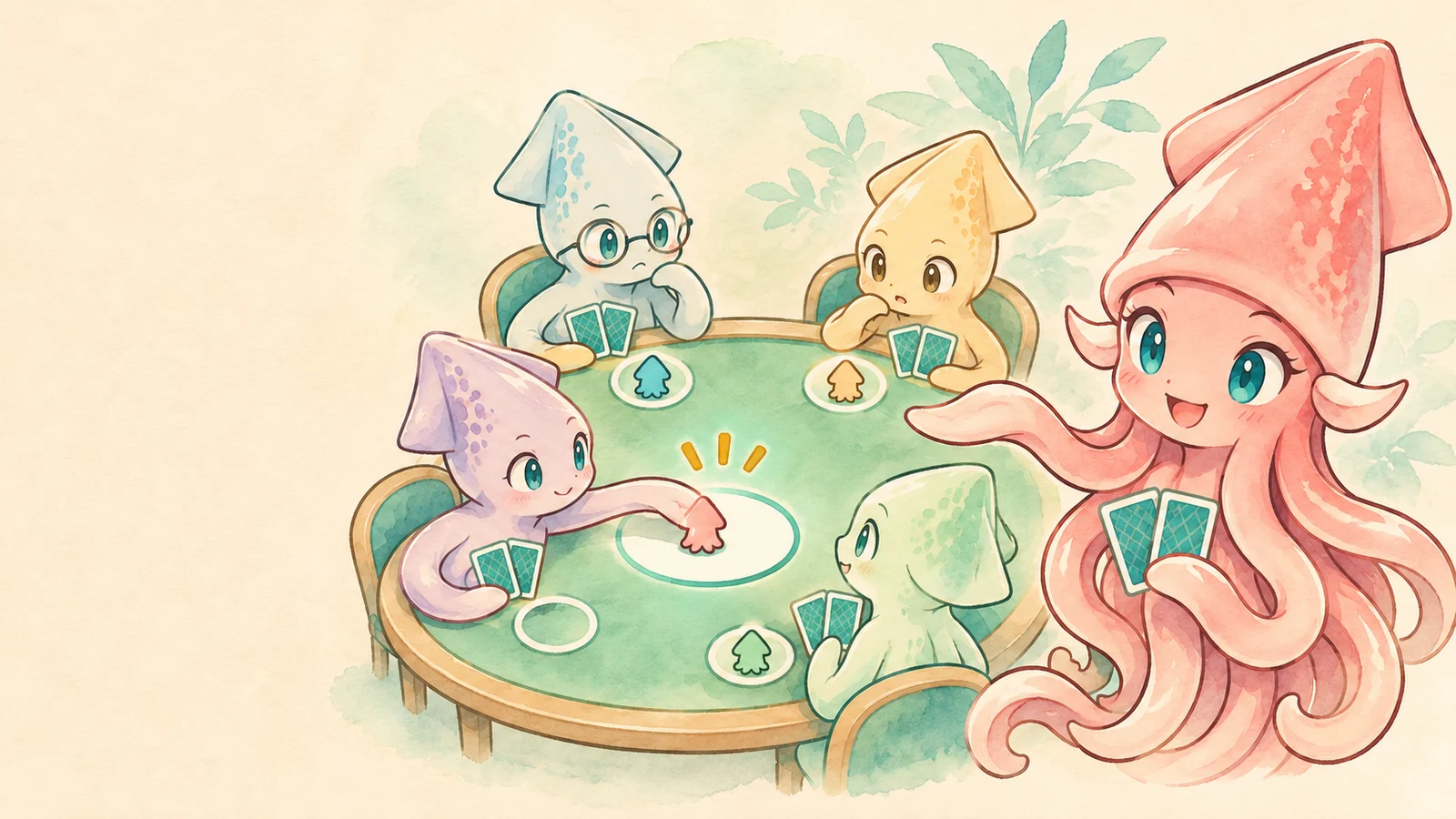
01 / Quick introduction
Alongside regular poker, participants agree to a settlement tied to winning eligible pots. Award conditions, supply and multipliers change the incentives.
Receive a token under the table rules. Entering a pot, winning a side pot or chopping may not qualify.
Classic formats usually allow one token per player; multi-token formats allow repeated awards. Review the holdings before the hand.
Classic rounds usually end with one player left without a token; finite multi-token rounds often end when supply runs out. Payment depends on the agreed rules.
Classic example: four players can each hold one token. After three players win a token, the remaining player pays the agreed amount to each of those three.
02 / Compare formats
Identify the format, then verify the specific session. These are comparison dimensions, not uniform rules for a region.
One token per player; usually ends with one player without a token. Related to stand-up formats.
Repeated awards, each with the same value. Several players may finish without a token.
Holdings trigger multipliers. Thresholds such as 3/5/7 or 3/4/5 are separate from multipliers such as 2/3/4 or 2/4/8.
N+3, N+4, fixed supply, first/last awards and chop carryovers need separate confirmation. There is no single global rule set.
“Unlimited” can mean unlimited holdings per player while round supply remains finite. Local names require complete terms before interpretation.
03 / Settlement demo
Try eight anonymous participants. See how zero-token counts and multiplier thresholds affect transfers. Inputs change this demo only.
Generic $ can represent any currency, chips or points. It does not specifically mean USD. Use one consistent unit for every input.
Enter the holding threshold on the left and its multiplier on the right. The first tier starts at one token; add or remove later tiers and edit any multiplier.
Example: 8 participants, N+3, 11 tokens; all holdings repriced at the current tier; each zero-token player pays in full.
A settlement if the current distribution were final, not a forecast of future profit. Excludes special awards and chop carryovers. Your actual tables are unaffected.
04 / Decision review
Compare folding, calling and raising with both ordinary poker value and the side-game incentives in view.
Action EV = poker chip EV + expected future net squid settlement under that action
Position, effective stacks, action sequence, rules, exact holdings and remaining supply. Separate known facts from gaps.
Consider your opponents’ thresholds as well as your own. Current transfers can be calculated; future opportunities need assumptions.
Separate evidence-based adjustments from the urgency of needing a token. An outcome does not validate the earlier decision.
Regular cash-game solutions provide a comparison. Without a full utility model, do not claim exact squid EV or optimal frequencies, or add a fixed bonus to every pot.
Read the full review template05 / Using ZenPoker
Web provides table rules, round management and hand snapshots. Record actual context; AI analyzes known facts and explicit assumptions.
Enable squid in table management and confirm value, supply and multipliers. Duplicating a table carries its fixed rules.
Use the existing roster. Holdings belong to round participants; a replacement player cannot inherit the previous player’s count.
New hands inherit table rules. Edit holdings next to the player and save an independent snapshot.
Examine incentives and action comparisons. Copy readable hand text; later table changes do not overwrite historical snapshots.
The independent app’s native squid workflow is in development. Read this topic now; app navigation will be added when the feature is available.
06 / Reading path
Understand tokens, rounds and payments before comparing classic and multi-token formats.
Read articleRules & settlementSeparate supply, individual caps, multiplier tiers and eligibility instead of relying on format names.
Read articleRules & settlementCalculate transfers for a specified distribution and distinguish tier jumps from future expected value.
Read articleDecision analysisCompare actions while accounting for payer status, multiplier thresholds and uncertain future settlement.
Read articleRecording & reviewA repeatable pre-hand and action-comparison template without hindsight or invented precision.
Read articleRecording & reviewUse Web table rules, round state and pre-hand snapshots, with clear boundaries for the app in development.
Read article07 / Sources & questions
Read by organizer and session. One broadcast does not establish worldwide adoption. Confirm the latest terms at the actual table.
US card-room example · September 9, 2022
A hand winner can sit down; the last standing player pays each other participant the agreed amount.
Jeju broadcast example · October 2024
Official coverage describes repeated awards, multipliers for multiple holdings and payments by zero-token players. Unpublished terms remain unconfirmed.
Season 7, Game 3 · November 14, 2026
This session lists N+4, 3/5/7/9 at 2/4/8/16×, plus first/last awards. Do not apply it to every KPC session.
Platform rules · April 21, 2026
Explicit eligibility, participation and departure rules. Its side-pot treatment does not automatically apply elsewhere.
Sources checked on November 18, 2026. Examples explain differences; they do not imply partnership or endorsement.
They are related side-game formats, but organizers use different token caps, multipliers and award conditions. Verify the full terms, not just the name.
Not necessarily. A player may hold multiple tokens while the round still has a finite supply such as N+3. Confirm both limits separately.
No. They are transfers if the current holdings were final. Future holdings and payer counts may change, and this table excludes poker betting costs.
A new round can explicitly start at zero. Missing historical information is not zero; preserve the gap and analyze conditionally.
Each platform uses its own workflow while sharing the rules, round state and hand-snapshot model. The native app flow is currently in development.