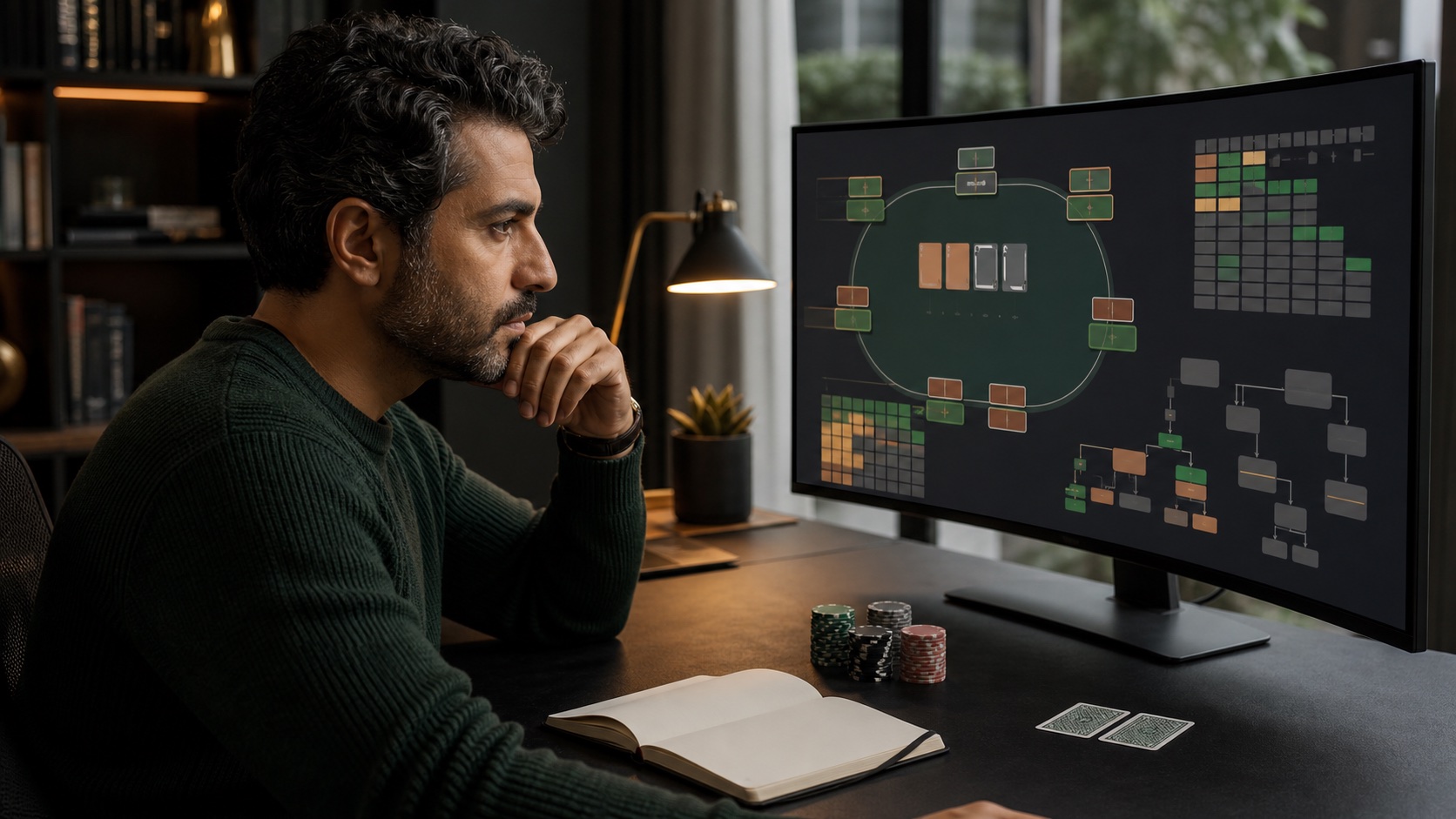
True masters do not simply win more hands than others; they upgrade themselves more effectively.
Many people claim they want to become skilled players.
However, if you extend the timeline a bit, you'll realize that most people actually desire not to "become skilled," but to "win a few hands quickly."
These two aspirations may seem similar, but they are fundamentally different.
The former is about long-term thinking, while the latter seeks immediate feedback.
The former is about building a system, while the latter chases results.
The former grows stronger over time, while the latter becomes increasingly fatigued.
And ZenPoker is designed for the former.
It is not a poker product that simply helps you pass the time, nor is it an ordinary AI tool that offers a few tactical suggestions.
ZenPoker's goal is to help those who truly want to become top players establish a complete growth system.
1. For Those Aspiring to Be Top Players, the Rarest Trait Is Not Diligence, but "Calibration Ability"
Many players are actually putting in a lot of effort.
They watch videos, memorize ranges, study solvers, grasp concepts, review hands, take notes, and even think daily about how to improve.
But why do so many people find themselves stuck after years of playing?
Because in the journey of high-level growth, effort is not the rarest commodity; calibration is.
You're not stuck because you haven't practiced enough.
The more common issue is:
- You've become too comfortable with incorrect instincts.
- You've mistaken results for quality.
- You're repeating an unexamined version of yourself.
- You think you're progressing, but you're merely accumulating experience without upgrading your understanding.
This is why some players have been in the game for years, becoming more "greasy" in their play, yet haven't truly improved.
They know the table well but not themselves.
They've encountered many situations but haven't established a stable upgrading mechanism.
What truly sets top players apart is not that they never make mistakes, but that they can identify their errors more quickly and upgrade themselves faster.
ZenPoker aims to address this very issue.
2. Ordinary Tools Help You "Record," ZenPoker Helps You "Grow"
Many tools on the market can help you keep records.
Recording hands, tracking wins and losses, noting opponents, logging results.
These certainly have value, but if you stop there, it's far from enough.
Because recording alone does not automatically lead to growth.
Writing down a hand doesn't mean you've truly understood it.
Noting an opponent's name doesn't mean you've really built their profile.
Saving a session doesn't mean you've extracted your own leaks.
What truly creates a gap is not "how much you've recorded," but:
- Can you quickly return to key spots?
- Can you separate results from decision quality?
- Can you identify recurring error patterns in your play?
- Can you distill opponent information into actionable cognitive assets?
- Can you transform reviews from emotional reflections into a stable training system?
Ordinary tools are warehouses.
ZenPoker is a training ground.
This is the essential difference.
3. True Masters Must Train Three Aspects: Skills, Cognition, and Mindset
Many players have a one-dimensional understanding of "becoming stronger."
They think becoming stronger means:
- Learning more theory
- Memorizing more ranges
- Analyzing more solver outputs
- Committing more standard lines to memory
While all of these are important, they only form part of what makes a top player.
True elite players are simultaneously training in at least three areas:
1. Skills: Playing the Hand Correctly
This is the foundational layer.
It includes:
- Understanding position
- Range thinking
- GTO framework
- Exploitative adjustments
- Awareness of pot odds and SPR
- Betting logic across different board textures
Without this layer, growth lacks a solid foundation.
2. Cognition: Seeing the Game Clearly
Many players have decent skills, but what truly holds them back is their cognition.
For example:
- Confusing "this hand was played well" with "this hand had a good outcome"
- Failing to recognize when they are most prone to emotional reactions
- Struggling to extract the real decision-making issues from a hand
- Collecting information about opponents in a fragmented, unstructured way
- Focusing on surface actions during reviews, without revisiting the underlying mental processes
Skills can be taught; cognition requires continuous refinement.
3. Mindset: Keeping Yourself Steady
The poker table is a very harsh environment.
It magnifies your greed, fear, impatience, slowness, and obsessions.
Many players don't struggle with the game itself, but rather with maintaining composure at critical moments.
- Knowing they should fold, yet calling out of stubbornness
- Understanding they should value bet, but hesitating out of fear of being caught
- Recognizing they are on tilt, yet unable to stop
- Experiencing a single bad beat, but turning it into an ego battle
Thus, a true master is not just someone who can play well.
They are someone who can maintain decision quality amidst fluctuations.
The core philosophy of ZenPoker is to integrate these three layers:
Skills are the bones, cognition is the eyes, and mindset is the roots.
4. Why ZenPoker is the "Infrastructure for Top Players"
If you truly want to reach a higher level, you'll become increasingly aware of one thing:
Top players don't improve through a few moments of insight; they rely on a long-term, repeatable system.
What ZenPoker aims to provide is not a single answer but a comprehensive infrastructure for long-term training.
1. Quick Review: Keep Key Hands Fresh
Many growth opportunities are lost not due to a lack of skill but because of procrastination.
After playing a key hand, if you don't analyze it immediately while the memory is still fresh, many details will quickly fade:
- Why you hesitated at that moment
- The impression your opponent gave you
- Your emotional triggers
- Which part of your action felt the most uncomfortable
ZenPoker's quick review feature is designed to help you capture key hands in the shortest possible time.
It's not just about adding another "record action"; it's about preserving the growth experience.
2. Opponent Names and Profiles: Solidifying the "Human" Element
Many low-level players focus solely on the cards.
Top players focus on the people.
The same HJ open and the same flop raise can have completely different meanings depending on who is behind them.
Therefore, true growth involves not only remembering "what happened" but also "who did it."
This is why ZenPoker emphasizes the importance of noting opponent names, comments, and subsequent profiles.
The advantage of top players often lies not in their understanding of a theoretical point but in their deeper, long-term understanding of people.
3. Direct Selection of Community Cards and Positions: Reducing Recording Costs, Increasing Review Density
A very practical issue is:
Many people don't avoid reviewing; they find it too cumbersome.
When the process becomes complicated and the actions numerous, people tend to procrastinate.
Once procrastination sets in, the review disappears.
Without reviews, growth halts.
Thus, a key principle in ZenPoker's product design is:
Make truly valuable actions shorter.
Directly selecting cards by position, choosing two hole cards at once, and completing community cards in one go may seem like minor interaction details, but they fundamentally serve an important purpose:
Minimizing the friction of growth.
Top players aren't necessarily those with stronger willpower.
They are often those who understand how to build systems better.
5. Why Relying Solely on Solvers Isn't Enough to Make You a Top Player
We certainly respect solvers.
In modern poker training, solvers are incredibly important tools. They help us establish a GTO framework, understand frequencies, scales, range interactions, and long-term equilibrium.
But if you think that "understanding a solver = becoming a top player," you are underestimating the true nature of competition.
Because what solvers can answer is:
- How to play theoretically
- What the optimal line is in an equilibrium world
- How frequencies and scales are distributed in a specific spot
But they cannot directly answer:
- Why you fail to execute in live settings
- Why you often lose control in certain spots
- How much this opponent deviates in reality
- Why you consistently turn correct knowledge into incorrect actions
- Whether your issues stem from technical skills or mental stability
Solvers give you the map.
ZenPoker helps you navigate.
For those who truly want to become top players, what they need most is not more maps, but a system that transforms maps into abilities.
6. ZenPoker Isn't Just Helping You Win a Hand; It's Helping You Build the "Expert Cycle"
What is the expert cycle?
It's the process where every time you play a hand, you not only accumulate results but continuously complete this chain:
Record → Review → Identify Issues → Correct Understanding → Adjust Actions → Validate Again
Once this cycle is established, growth becomes a consistent process rather than a series of random events.
What ZenPoker aims to do is make this chain smooth, short, and sustainable.
Because we believe:
- True improvement doesn't come from a single stroke of genius
- Real experts don't rely on inspiration to succeed
- The real gap is the compounding effect of long-term, high-quality reviews
A month later, you might just feel a bit clearer.
Three months later, you'll notice you've made fewer basic mistakes.
A year later, when you look back, you'll realize you are no longer the same person.
This is how true growth as an expert occurs.
7. Why Ambitious Players Should Start Using ZenPoker Early
Ambitious players fear two things:
First, moving slowly.
Second, going off course.
On the path of poker, going off course is more frightening than moving slowly.
Because moving slowly only incurs a time cost.
Going off course often means discovering years later that you've been training incorrectly all along.
You think you're accumulating knowledge, but in reality, you're solidifying mistakes.
You believe you're growing, but you're actually numbing your judgment with results.
You think you just lack a tool, but what you truly need is a complete upgrade system.
If you genuinely want to reach a higher level, the best thing to do is not to wait until you feel "in the zone" to take it seriously.
Instead, establish a proper system for yourself as soon as possible.
The sooner you engage in high-quality reviews, start compiling opponent profiles, and separate decision quality from results, the steeper your growth curve will be.
This is why those who truly aspire to become top players must use ZenPoker.
Not because it’s a “useful product.”
But because it represents a more advanced training method.
8. What We Truly Believe In Is Not "Winning Hands," But "Upgrading"
ZenPoker has never just aimed to help you win more.
We care more about:
- Whether you can become more aware
- Whether you can build more stable judgment
- Whether you can genuinely achieve self-upgrade from each hand
- Whether you can maintain a growth direction amid long-term fluctuations
Because we believe that top players are not defined by results.
Top players are those who can continually upgrade themselves.
And a product truly worthy of top players should not just provide answers.
It should act like a mirror.
Helping you see.
Helping you correct.
Helping you grow.
Helping you gradually become a higher-level version of yourself through each decision.
This is what ZenPoker aims to achieve.
And this is why those who genuinely want to become top players must use ZenPoker.