Introduction: A Question That Plagues Many
"Is Texas Hold'em really gambling?"
This question troubles countless players. Some argue that poker is a game of skill, while others insist it ultimately falls under the essence of "gambling." What’s even more perplexing is why some players become increasingly rational and clear-headed while others sink deeper, ultimately suffering both mentally and physically.
The answer lies in this: it’s not poker that is toxic, but your mindset.
This article will explore Dzongsar Khyentse Rinpoche's philosophy of "Poison is the Antidote" to reveal the fundamental differences between poker and gambling, as well as how to transform the poker table into a space for mental cultivation.
1. Poison is the Antidote: Things Themselves Are Not Toxic
Dzongsar Khyentse Rinpoche presents a core idea in "Poison is the Antidote":
Things themselves are not toxic; the toxicity lies in the "grasping and attachment of the mind."
This perspective overturns our binary judgments of "good" and "bad." Alcohol can be poison (leading to addiction) or an antidote (for relaxation in moderation); money can be poison (greed and attachment) or an antidote (creating value).
The key is not the things themselves, but your relationship with them.
In the context of poker:
- Gambling Mindset: Using poker to escape reality, seek thrills, and equate winning and losing with self-worth → Poison
- Cultivation Mindset: Using poker to train awareness, refine rationality, and recognize habitual tendencies → Antidote
II. The Nature of Gambling: The Five Poisons Revealed
Why does gambling harm the mind? Because the gambling environment amplifies the "Five Poisons" inherent in human nature:
Expressions of the Five Poisons in Gambling
| Five Poisons | Psychological Traits | Expressions in Gambling | Outcomes |
|---|---|---|---|
| Greed | Desire for quick wins, doubling up | Increasing bets, chasing overnight riches | Loss of control |
| Hatred | Anger when losing, desire for revenge | Betting more when losing, emotional betting | Greater losses |
| Delusion | Belief in luck and fantasies | Ignoring probabilities, believing in "good fortune" | Self-deception |
| Pride | Arrogance after wins | Excessive confidence, lowering defenses | Blind risks |
| Doubt | Self-doubt, questioning strategies | Indecisive choices, losing direction | Continuous losses |
Fundamental Errors of Gambling:
- Relying on luck to turn things around → Escaping reality → Greater loss of control
- Equating wins and losses with self-worth → Heavier emotional attachment → Emotional decline
- The more you lose, the more you gamble; the more you gamble, the more you lose → Deepening of the Five Poisons → Damage to both body and mind
III. The Essence of Poker: A Path of Cultivation
So, why can poker serve as an "antidote"?
Because poker offers three elements that gambling lacks:
1. Replayability
Gambling: Instant results, no replay, only attributed to "luck."
Poker: Every hand can be reviewed in detail:
- What is your range?
- What is your opponent's range?
- Is your decision based on emotion or probability?
- In the long run, what is the EV of this decision?
Reviewing is the starting point of awareness.
2. Skill Growth
Gambling: Purely a game of chance (like baccarat or roulette); no matter how hard you try, you will lose in the long run.
Poker:
- Learning GTO (Game Theory Optimal)
- Analyzing opponent tendencies
- Managing bankroll
- Controlling emotions
The growth of skills leads to the growth of mindset.
3. Mirror Effect
Poker acts as a mirror, reflecting your inherent tendencies:
- Greed: Wanting to go all-in with Aces
- Hatred: Going on a crazy bluff after a bad beat
- Delusion: Ignoring opponent ranges, believing "this time I will definitely win"
- Pride: Lowering your guard after winning several hands
- Doubt: Hesitating with marginal hands
Poker does not create the Five Poisons, but it reveals them.
Seeing is the starting point for transformation.
4. The Divide: Gambling vs. Poker
| Dimension | Gambling | Poker (Mindset of Practice) |
|---|---|---|
| Decision Basis | Luck, Intuition | Probability, Information, Strategy |
| Replayability | Cannot be reviewed | Every hand can be thoroughly reviewed |
| Skill Growth | No skills involved | Continuous learning, continuous growth |
| Long-term Results | Inevitably loses to probability | Good skills can lead to long-term profits |
| Mental Impact | Amplifies negative traits | Cultivates positive traits |
| Core Goal | Escape, thrill, quick money | Awareness, growth, self-cultivation |
5. Why Do Some Players Fall into Gambling Despite Playing Poker?
Because they lack the right mindset.
Even in poker, if you:
- Don’t review: Always attribute losses to "bad luck"
- Don’t learn: Never study ranges, probabilities, or GTO
- Don’t reflect: Fail to recognize your emotional patterns
- Aren’t rational: Chase "doubling up" instead of "maximizing EV"
Then you’re not playing poker; you’re engaging in gambling disguised as poker.
6. How to Transform Poker into a Path of Practice?
1. Establish a Review Habit
After each session:
- Review key hands
- Analyze your decision-making logic
- Examine emotional fluctuations
- Record in the "Hand Awareness Journal" (see related articles)
2. Learn GTO and Exploitative Strategies
- GTO: The game-theoretic optimal solution, the rational framework
- Exploitative Strategies: Adjustments based on opponent tendencies
Rationality isn’t cold; it’s clear and liberating.
3. Train Your Awareness
In every hand, ask yourself:
- What emotion am I feeling right now?
- Is this decision based on probability or emotion?
- Am I on tilt?
Awareness is the core of practice.
4. Replace Negative Traits with Positive Ones
| Negative Traits | Transformation | Positive Traits |
|---|---|---|
| Greed → See the essence of greed → | Non-greed (Clear): Only make EV optimal plays | |
| Anger → Recognize the futility of anger → | Non-anger (Gentle): Avoid tilt | |
| Delusion → See the emptiness of fantasies → | Non-delusion (Bright): Reason with probabilities | |
| Sloth → Recognize the blindness of pride → | Non-sloth (Right): Reflect on wins and losses | |
| Doubt → See the root of inner uncertainty → | Non-doubt (Decisive): Make clear and confident decisions |
VII. Conclusion: The Poker Table as a Dojo
ZenPoker's goal is not to teach you how to win against others, but to teach you how not to lose to yourself.
Poker is not gambling, nor is it merely a technical game.
Poker is a mirror that reflects your heart.
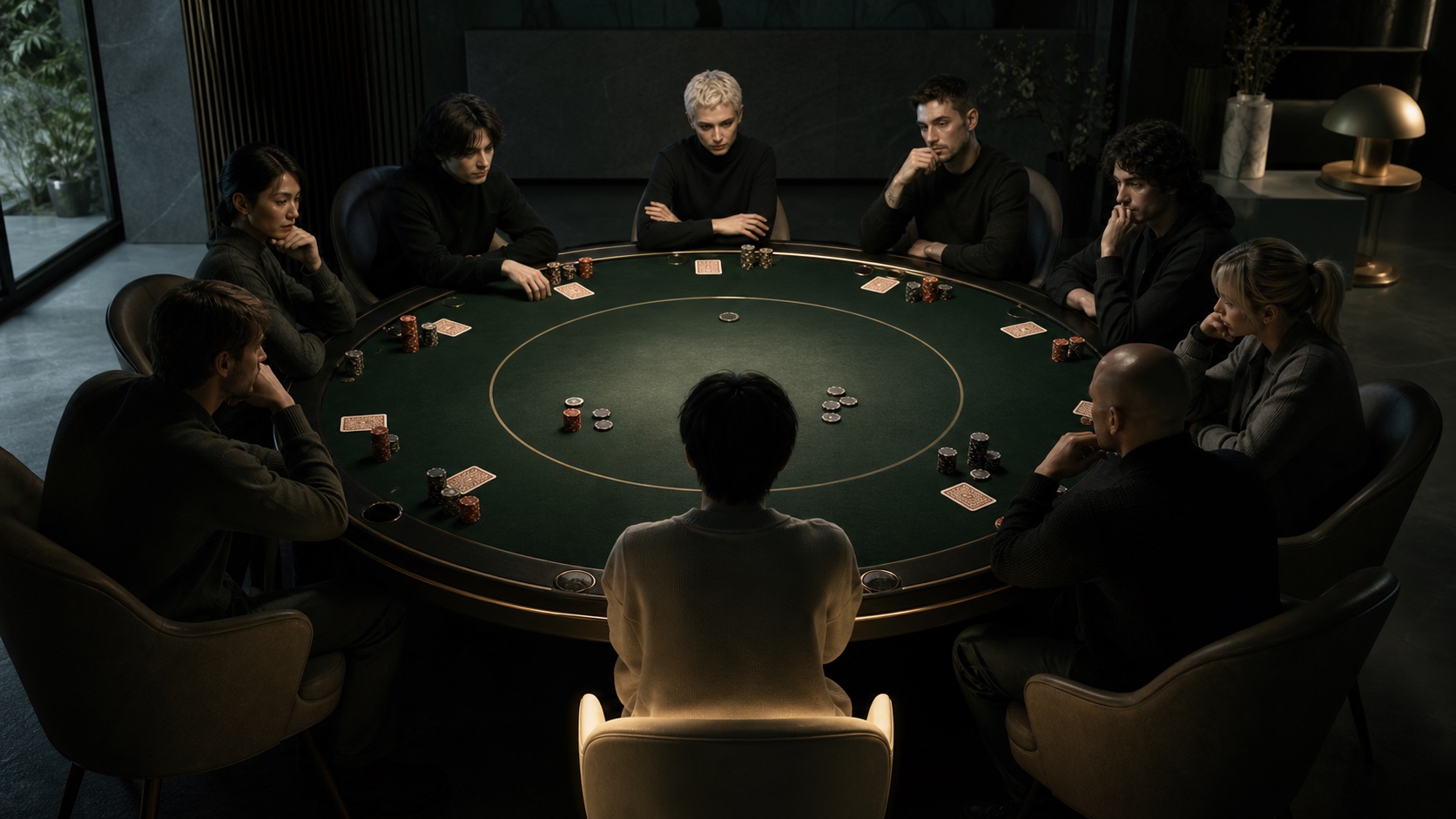
Poker is a dojo, a place to cultivate your awareness and rationality.
The poison is the antidote.
The key is not whether you play poker, but how you relate to it.
If you can maintain awareness in every hand,
If you can stay rational in every decision,
If you can see yourself in every review,
Then the poker table is your dojo.
Next Steps for Reading
- Winning by Not Being Greedy: How to Transition from Five Poisons to Five Blessings
- Detailed Explanation of the Five Poisons, Five Blessings, and Five Elements Cultivation System
- Poker Awareness Journal Template
The Poker Table as a Dojo · Winning by Not Being Greedy