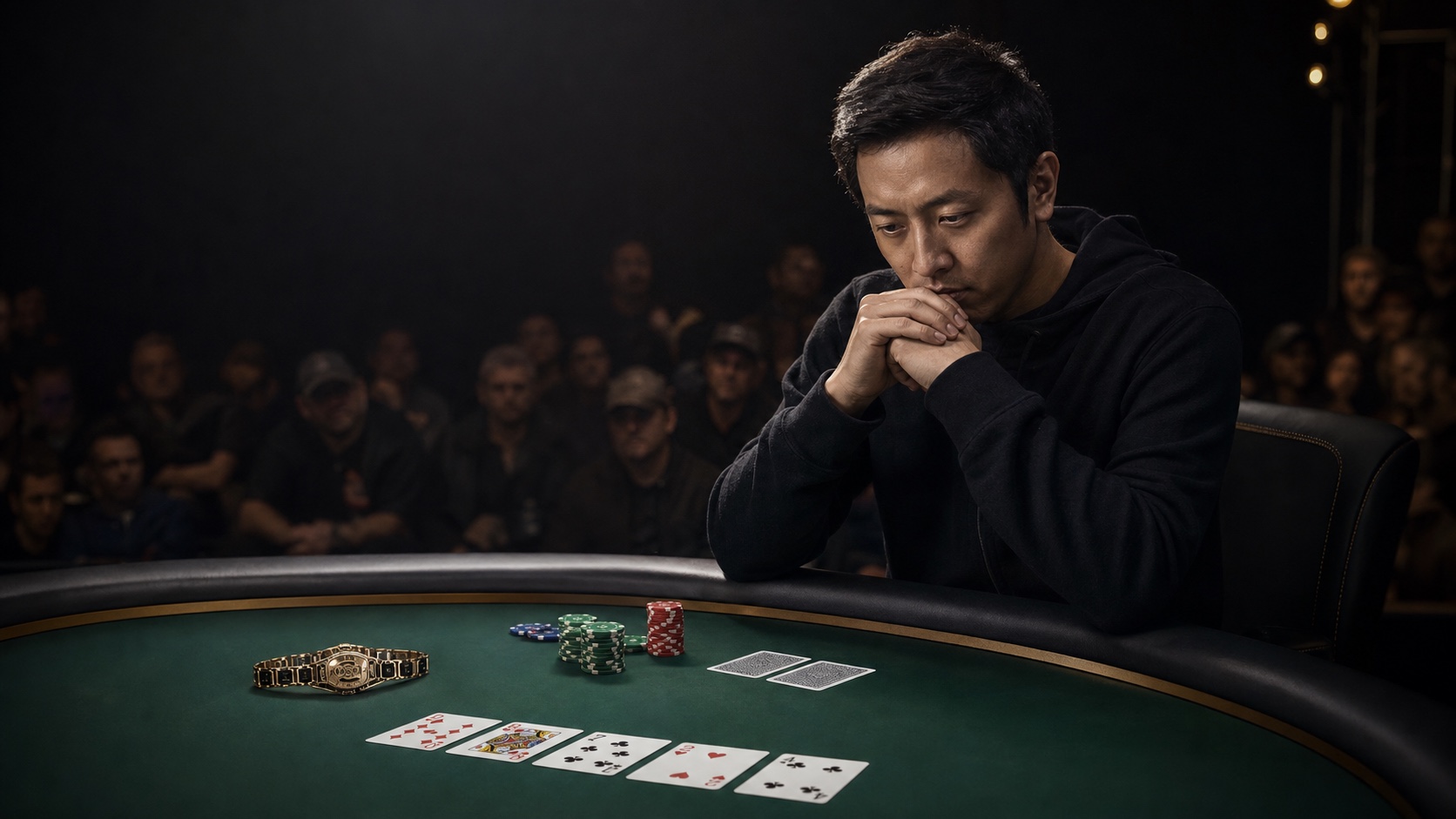
The bracelet belongs to the result. The quality of the decision belongs to the player. The world may take the first from you. You do not have to surrender the second.
The most breathless moment at a WSOP final table is often not a brilliant bluff.
It is the moment after all the chips have gone into the middle.
The players stand.
The rail leans toward the table.
The broadcast displays the equities.
One player is far ahead. The other has only a few outs. The bracelet, the title, and the life-changing payout seem close enough to touch.
Then the river falls.
One card completes a straight, a flush, or two pair. In seconds, the favorite can go from likely champion to runner-up, or even to the rail.
Even neutral viewers feel the blow:
How can someone do everything right and still lose everything that mattered?
That is the cruelty and the beauty of multi-table tournament poker.
A player can spend years building the skill, discipline, and judgment required to reach a particular door. Whether that door opens this time may still depend on a card no one can control.
This is why a WSOP gold bracelet is never just a prize.
It is a mirror under the brightest possible light.
1. Why One Gold Bracelet Can Carry So Much Weight
In material terms, a bracelet is a trophy.
For many players, however, it carries far more than its metal:
- Years of invisible work are finally seen.
- Every downswing appears to have found its answer.
- Doubts from friends and family seem to fall silent.
- The player finally has proof that they were good enough.
- An ordinary name may become part of poker history.
- Sponsorships, invitations, reputation, and career opportunities can change overnight.
The player is not merely chasing jewelry. They are chasing everything the bracelet has come to represent:
recognition, remembrance, and permission to say, "I really could do it."
This is also why finishing second can hurt so much.
The runner-up is not left with nothing. They may win life-changing money and record the best result of their career. Yet once the bracelet has felt close, second place can be experienced as a loss rather than an achievement.
Human beings do not measure happiness only against an absolute result.
We also compare reality with the person we almost became.
2. Why MTT Poker Feels More Like Fate
In a cash game, you can reload, change tables, or leave when you are no longer playing well.
An MTT offers no such reset.
The blinds keep rising. Elimination is irreversible. ICM pressure grows. Every event contains an opportunity window that will never exist in precisely the same form again.
As you move from thousands of entries to the final two tables, the final table, and heads-up play, the leverage of every decision increases.
The same river card that changes a pot by a few dozen big blinds in a regular game can change all of the following at a WSOP final table:
- Hundreds of thousands or millions of dollars
- The identity of champion and runner-up
- Ownership of a gold bracelet
- A player's future career
- How the media, the audience, and poker history remember them
- The story they will tell when looking back on their life
The card's mathematical probability has not changed. The amount of life attached to its outcome has.
This is the fate leverage of tournament poker.
Two players of nearly equal ability can leave a few high-leverage moments with radically different earnings, reputations, and life stories.
History records who won the bracelet. It rarely records that the distance between two careers may have been a single river card.
3. Can Luck Really Overpower Skill?
The answer depends on the scale at which we look.
In One Hand, Absolutely
Skill can help you put your chips in with 80% equity.
It cannot turn 80% into 100%.
Once the chips are committed, the player's decision is temporarily finished and the deck begins to speak.
A world-class player can read the range correctly, choose the highest-EV action, and still lose to the 20% branch.
That does not mean skill failed.
It means skill completed all the work that skill was capable of doing.
In One Tournament, Often
A large-field MTT requires the winner to survive many high-variance moments:
- Coin flips
- Short-stack push/fold decisions
- Kings running into aces
- Set over set
- Favorites being outdrawn
- Underdogs getting there
- Bubble and final-table ICM thresholds
Elite players can increase the frequency with which they cash, make deep runs, and reach final tables.
They cannot schedule the year in which they will win.
Across a Career, Luck Can Still Leave Permanent Marks
Long-term EV is mathematically sound, but a human life is not an infinite sample.
How many events with the same field size, structure, and level of competition can a live MTT player enter in one career?
Tournaments change. Opponents change. Health, focus, bankroll, and family responsibilities change. By the time variance is theoretically supposed to converge, life may already have moved into a different stage.
A slightly weaker player can own a bracelet. A stronger player can finish a career without one.
That does not prove the first player lacked skill, nor does it prove the second did not work hard enough.
It reveals a more honest relationship between ability and luck:
Skill determines how often you arrive at the door with an edge. Luck determines whether the door opens this time.
4. Why an 80% Favorite Feels Like a 100% Owner
Imagine getting all-in before the river with 80% equity.
Mathematically, that means:
- Across enough similar situations, you will win roughly eight times out of ten.
- This hand still contains a real 20% chance of losing.
- No champion has been decided, and no result belongs to anyone yet.
Emotion does not process probability so calmly.
When the broadcast shows 80%, the commentators begin discussing victory, and the rail prepares to celebrate, we start possessing the future before it arrives.
We imagine:
- The photograph with the bracelet
- The winner's interview
- The money in the account
- The reaction from family and friends
- The sentence we will finally be allowed to say about ourselves
The river beat then feels like more than failing to win.
It feels as if something already owned has been taken away.
This is counterfactual pain:
If the river had been anything else, my life would be different.
The river did not steal a guaranteed championship. It realized the less likely branch of reality.
But in the human heart, an 80% hope can feel like 100% ownership.
5. Why "You Played It Right" Is Not Enough
After a brutal river, people often say:
- You did nothing wrong.
- You won in EV.
- That is just variance.
- Keep playing the same way.
Technically, these statements may all be true.
But the player did not lose an abstract unit of EV. They lost this WSOP, this final table, and this unrepeatable timeline.
Mathematics can confirm that the decision was correct. It cannot redeal a tournament that has already ended.
ZenPoker does not use long-term thinking to silence genuine pain.
A fuller truth is:
You made a high-EV decision. That is a technical victory.
You lost an irreplaceable chance to become champion. That pain is also real.
Both can be true at the same time.
Accepting variance does not require an immediate smile.
Understanding probability does not cancel grief.
A stable poker player is not someone who feels nothing. It is someone who does not allow one cruel outcome to destroy a decision system built to remain correct over time.
6. The Bracelet Becomes Dangerous When It Judges Your Worth
There is nothing wrong with wanting a bracelet.
A clear goal gives training direction. It helps a player endure the solitude, repetition, and uncertainty of a professional path.
The danger begins when the goal becomes an identity verdict:
Only a bracelet will prove that I succeeded.
Only becoming a champion will prove that I am good enough.
Once the bracelet becomes the judge of self-worth, the player assumes responsibility for too many uncontrollable variables.
They may begin to:
- Use one tournament to evaluate years of ability
- Let one river card invalidate an entire decision process
- Become unable to accept ordinary results after getting close to greatness
- Overplay the next event in an attempt to erase regret
- Turn "I did not win this time" into "I do not deserve to win"
A title evaluates an outcome. It does not measure the whole person.
A bracelet can prove that you won one tournament. It cannot fully prove your skill, character, courage, or clarity.
In the same way, the absence of a bracelet cannot prove that those qualities are absent.
7. A Complete MTT Player Trains Two Different Abilities
The first ability is to move closer to the championship.
It includes:
- Range construction
- Bet sizing
- ICM judgment
- Stack-depth strategy
- Opponent profiling
- Physical and mental endurance
- Bankroll management
- Final-table experience
- Rehearsal for high-pressure decisions
The second ability is to survive the championship not arriving.
It includes:
- Separating decision quality from outcome
- Allowing disappointment without collapsing into self-rejection
- Seeing the hunger for fame, proof, and recognition
- Refusing to use the next tournament to avenge the previous river
- Preserving the capacity for the next correct decision after the uncontrollable occurs
The first ability helps you reach the final stages more often.
The second allows you to keep moving when the final stage does not reward you.
Many players train only the first. Their strategy grows stronger while their inner foundation grows more fragile.
A mature competitor must train both.
8. Three Stages After a Career-Defining Bad Beat
Stage One: Allow the Pain
Do not immediately lecture yourself about EV. You do not need to perform professional composure for other people.
Losing a championship opportunity deserves grief. It is not weakness. It is the process of saying goodbye to a possible life that felt very close.
An emotion needs to be seen before it can be released.
Stage Two: Review What Was Controllable
Once the emotion has settled, examine only what you could control at the time:
- Was the range assessment reasonable with the information available?
- Was there a better sizing?
- Was the ICM risk evaluated correctly?
- Did the opponent profile miss an important clue?
- Was this a technical mistake or simply variance?
If the decision was correct, do not let the river rewrite it as a mistake.
The deck can change the finishing position. It cannot change the information available when the decision was made.
Stage Three: Let Go Without Pretending It Did Not Matter
Letting go does not mean saying, "It was not important."
A more honest statement is:
It mattered, and I truly lost it.
But this loss does not have to destroy the quality of my next choice.
The sadness may remain. Self-rejection does not have to follow it.
9. What a WSOP Final Table Teaches Beyond Winning
| What Happens at the Table | What It Reveals About Life |
|---|---|
| The favorite can still be eliminated | An advantage is not a guarantee |
| The underdog can still recover | A disadvantage is not a verdict |
| A correct decision can lose | Good process is not always rewarded immediately |
| A bad decision can win | A good result does not prove a good process |
| A few moments can decide the title | Chance often magnifies a small number of life events |
| Long-term EV needs a huge sample | A finite life may never receive perfect fairness |
| Control ends after the all-in | After doing our best, we still have to make room for uncertainty |
Poker never honestly promises:
If you keep making correct decisions, you will eventually receive everything you deserve.
That sentence is comforting, but it is not guaranteed.
Poker offers a harder and more liberating lesson:
We continue improving the quality of our decisions even when the world does not promise to reward them.
We do this not because correctness guarantees a prize, but because the decision is the part for which we can take responsibility.
That is more difficult than believing that good luck must eventually arrive.
It is also more free.
10. The Bracelet Is Not the Moon, and Neither Is Poker
Zen Buddhism offers a famous image:
A finger points toward the moon, but the finger is not the moon.
If we stare only at the finger, we miss what it is pointing toward.
The WSOP bracelet is also a finger.
It can point toward excellence, courage, long commitment, and competitive dreams. It is not the complete value of a person.
Poker itself is another finger.
We study GTO, EV, ICM, ranges, and exploitative adjustments to make better decisions. But if our learning leaves us only more attached to winning and losing, we are still staring at the finger.
What poker truly points toward is the person making the decisions:
- Why do I need so badly to be proven?
- Why do I treat high probability as an entitlement?
- Can I endure being correct without being rewarded?
- When I win, do I mistake luck for ability?
- When I lose, do I mistake the result for myself?
- When the world deals a card I did not expect, can I remain clear?
Another champion will wear the bracelet.
The prize money will be spent.
New hands will replace the old ones.
The applause will eventually become quiet.
What remains is the person you gradually learned to see through repeated encounters with uncertainty.
Poker is not the destination.
It is the hand pointing toward the moon.
Through one hand, we see decision-making. Through one opponent, we see human nature. Through winning and losing, we see our own greed, fear, attachment, and refusal to let go.
When the question changes from "Why didn't I win that bracelet?" to "What did this loss allow me to see?", poker begins to transform from competition into practice.
The ZenPoker Principle
Before the all-in, do everything within your power. After the all-in, respect what cannot be controlled.
Skill moves us closer to victory.
Awareness allows us to endure victory not arriving.
A gold bracelet is the glory of one journey. It is not the end of knowing yourself.
Poker is only the hand pointing toward the moon. The true direction is the journey toward self-knowledge.
ZenPoker AI Master — See the hand. See the opponent. See yourself.