Introduction: A Misunderstood Classic
Rounders (1998) is the awakening film for countless poker players.
Many viewers' first reactions are:
- "That was so exciting! I want to play poker too!"
- "The protagonist turned his life around with poker and achieved his dreams!"
- "As long as your skills are good enough, you can win big money!"
But these are misunderstandings.
What this film truly conveys is not about turning your luck around, but rather:
- Awakening: Recognizing who you really are
- Discipline: Maintaining rationality amidst temptation
- Letting Go of Attachment: Playing not to prove yourself
This article will deeply analyze this classic from the perspective of mental cultivation.
I. The Protagonist's Three "Deaths" and "Rebirths"
First Death: Blown Up by KGB
Plot Recap:
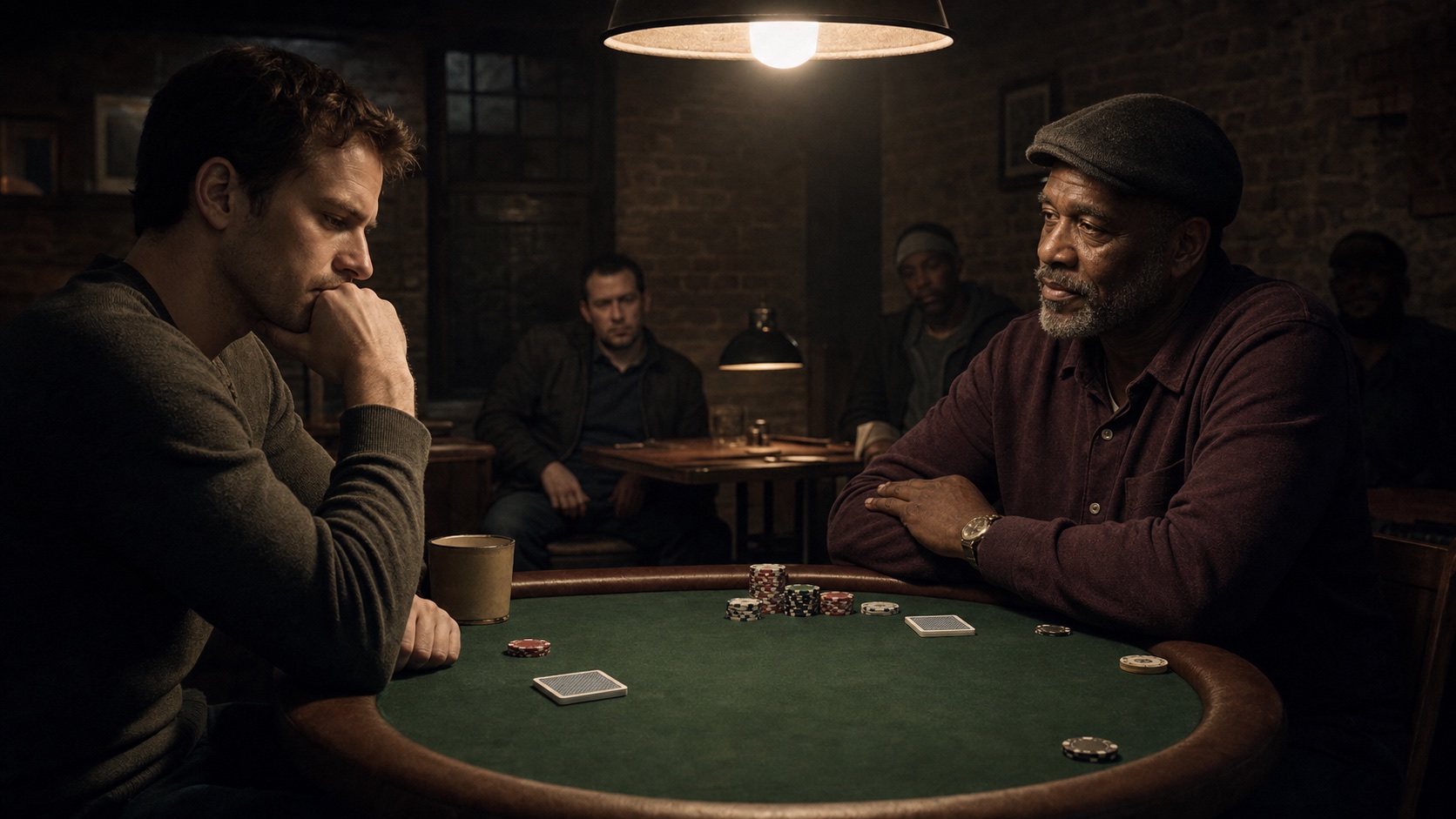
At the beginning of the film, the protagonist Mike faces off against the Russian mob boss KGB in an underground poker game. Holding a Full House, Mike confidently goes all-in, only to find that KGB has an even bigger Full House. Mike loses all his chips, and his mental defenses crumble.
Psychological Interpretation:
This marks Mike's first death—his self-perception collapses.
- Pride: Mike believes his skills are sufficient to control everything.
- Greed: He wants to win quickly to prove himself.
- Doubt: After losing, he begins to question his abilities.
This failure is the starting point of his journey.
Second Death: Dragged Down by Friend Worm
Plot Recap:
Mike vows to quit poker and focus on law school. However, when his friend Worm is released from prison, heavily in debt, he begs Mike for help. Soft-hearted, Mike returns to the poker table, but Worm is a cheating gambler, leading Mike into deeper trouble.
Psychological Interpretation:
This represents Mike's second death—he loses his sense of direction.
- Fantasy: Mike fantasizes that he can "help a friend," ignoring reality.
- Anger: He feels anger towards Worm's actions but can't walk away.
- Indecision: He wavers between "doing the right thing" and "helping a friend."
This failure reveals the cost of his obsession.
Third Rebirth: Confrontation with KGB Again
Plot Recap:
To pay off his debts, Mike decides to challenge KGB once more. This time, he is not trying to prove himself but rather to accomplish a mission.
During the game, Mike calmly observes and identifies KGB's weaknesses (KGB squeezes an Oreo cookie when bluffing). Ultimately, Mike wins the confrontation through rationality and discipline.
Psychological Interpretation:
This is Mike's rebirth—he discovers his true self.
- No Greed: He no longer seeks to "double up" but focuses on making the right decisions.
- No Anger: He is no longer angry but observes calmly.
- No Fantasy: He faces reality instead of indulging in illusions.
- No Pride: He remains humble rather than arrogant.
- No Indecision: He executes his plans with conviction.
This victory is not based on luck, but on awakening.
II. KGB: The Embodiment of the Five Poisons
KGB is the antagonist in the film, but he also serves as a mirror for Mike.
The Five Poisons of KGB
- Greed: He seeks the thrill of winning, reveling in the feeling of control.
- Anger: He loses his temper when he suffers a bad beat.
- Delusion: He believes in his own intimidation, overlooking his opponents' strengths.
- Pride: He is arrogant and underestimates Mike.
- Doubt: He wavers at critical moments (to call or to fold?).
KGB is not the enemy; he is a projection of Mike's inner five poisons.
When Mike defeats KGB, he is not overcoming an opponent but conquering the five poisons within himself.
III. Worm: The Cost of Obsession
Worm is Mike's friend, but he represents another form of downfall:
Worm's Issues
- Greed: He wants to make a quick comeback, even if it means cheating.
- Anger: He is furious about his situation but fails to reflect.
- Delusion: He fantasizes about making a "big bet" to turn things around.
- Pride: He refuses to acknowledge his problems, always making excuses.
- Doubt: He lacks conviction and goes with the flow.
Worm is not a bad person; he is someone controlled by the five poisons.
Mike ultimately chooses to leave Worm, not out of injustice, but because he realizes:
You cannot save someone who is unwilling to awaken.
IV. The Secrets of Mental Discipline in the Film
1. "It's Not About the Cards, It's About the People"
There is a classic line in the film:
"Play the player, not the cards."
The deeper meaning of this statement is:
- No-Limit Hold'em is not a game of probabilities; it's a game of psychology.
- Your opponent is not the cards but your own mind.
- A true master is someone who can see themselves.
2. "I Can Only Control My Decisions"
In the end, Mike says:
"I can't change the cards I'm dealt, but I can control how I play them."
This is the essence of poker practice:
- Let go of attachment to outcomes.
- Focus on making the right decisions.
- Embrace uncertainty.
3. "Winners Rely on Discipline, Not Luck"
In the film, Mike's greatest transformation is not in technical skills but in establishing discipline:
- No more impulsive all-ins.
- No longer controlled by emotions.
- No more playing to prove a point.
Discipline = Awareness + Rationality + Execution.
V. From Film to Reality: How to Apply It?
1. Establish a Review Habit
Mike reviews after every game:
- Were my decisions correct?
- What are my opponents' behavioral patterns?
- Was I influenced by my emotions?
Reviewing is the starting point of awakening.
2. Identify Your "KGB"
Everyone has a KGB within—representing your five poisons.
- What is your "greed"?
- What is your "anger"?
- What is your "ignorance"?
Seeing it is the beginning of transformation.
3. Let Go of Attachment, Focus on the Process
Mike ultimately did not stay at the poker table but went to Las Vegas—not to make money, but to be himself.
True victory is not about how much money you win, but about conquering yourself.
VI. Classic Quotes from the Movie and Their Interpretations
1. "Pay that man his money."
Scene: After KGB loses to Mike, he calmly says, "Pay him."
Interpretation: True masters do not lose control over wins and losses. They accept the outcome and remain composed.
2. "It's immoral to let a sucker keep his money."
Scene: The "insider lingo" of professional players.
Interpretation: This statement may seem cold-blooded, but it reveals the essence of poker: the weak will be eliminated, and the strong will survive. However, "strong" does not refer to the technically best player, but to the one with the most stable mindset.
3. "I'm not playing for the money. I'm playing to win."
Scene: Mike explains why he plays poker.
Interpretation: This represents the highest realm of non-greed—not pursuing money, but striving for the correctness of the process.
VII. Conclusion: Awakening is the True Victory
"Rounders" is not an "inspirational film," but rather a film about "awakening."
It teaches us:
- Poker is not gambling; it is a path of cultivation.
- The true enemy is not your opponent, but your own vices.
- Victory is not about how much money you win, but about conquering yourself.
Mike's story is the story of every poker player.
Will you be controlled by your vices like Worm, or will you awaken like Mike?
Next Steps for Reading
- Poker is Not Gambling: The Line Between Poison and Antidote
- Winning by Not Being Greedy: How to Move from Five Poisons to Five Blessings
- Poker Awareness Journal Template
The Poker Table is a Place of Cultivation · Winning by Not Being Greedy