Introduction: The Same Wisdom on Two Boards
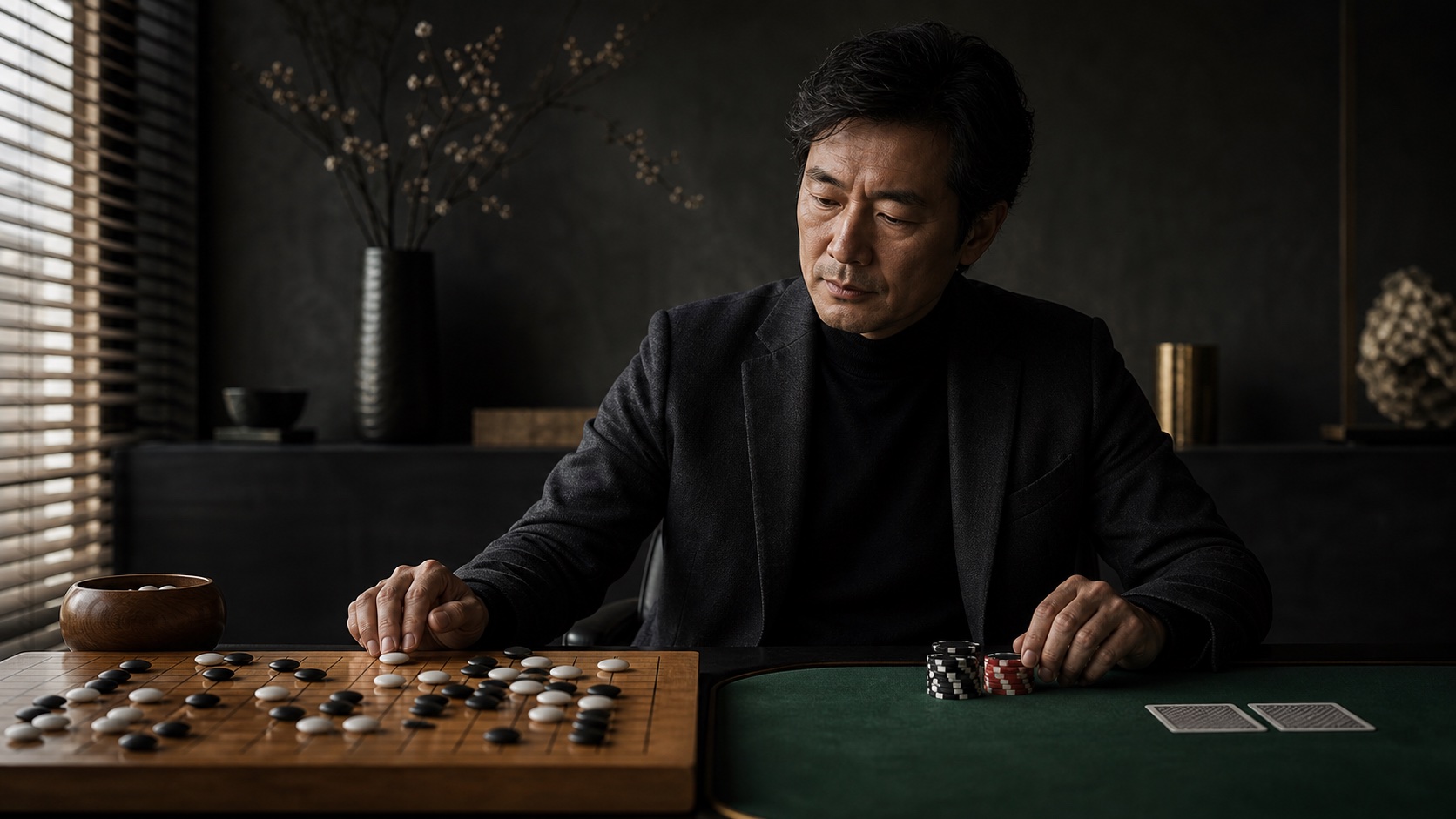
Lee Chang-ho, the legendary Korean Go player, a 16-time world champion, is known as the "Stone Buddha."
In his autobiography, "Do Not Covet Victory," he writes:
"I never pursue big wins; my goal is to win just half a point with each move."
"A 51% win rate, accumulated over time, is an absolute advantage."
This statement has resonated throughout the Go community and across all competitive fields.
Because this is the essence of Texas Hold'em.
This article will deeply analyze:
- Lee Chang-ho's philosophy of "Do Not Covet Victory"
- The fundamental similarities between Go and poker
- How to practice "Do Not Covet Victory" at the poker table
- Why "coveting victory" is the greatest trap
1. Lee Chang-ho: The Wisdom of the Stone Buddha
1.1 What Does "Do Not Covet Victory" Mean?
Lee Chang-ho's Go style is known as "half-point victory":
- No Pursuit of Major Wins: Even when opportunities arise to capture large groups or secure significant territory, he avoids taking risks.
- Focus on Small Wins: Each move aims to gain a slight advantage (half a point).
- Accumulating Small Wins for Major Victory: By amassing numerous small advantages, he ultimately wins the game.
Result: His win rate is astonishing, with 16 world championships, dominating the Go scene for over a decade.
1.2 Why is "Do Not Covet Victory" So Effective?
Reason 1: Reducing Risk
The Covetous Player:
- Sees opportunities and thinks of "total annihilation."
- Takes huge risks in pursuit of major wins.
- Once they fail, everything collapses.
The Non-Covetous Player (Lee Chang-ho):
- Chooses the option with the least risk and stable returns for every move.
- Even in the event of a mistake, losses remain manageable.
- In the long run, the lower the risk, the higher the win rate.
Reason 2: Avoiding Emotional Fluctuations
The Covetous Player:
- Mindset fluctuates dramatically with wins and losses.
- Feels pride when winning, collapses when losing.
- Emotions cloud judgment.
The Non-Covetous Player:
- Each game is viewed as a "small win" or "small loss."
- Maintains a steady mindset, unaffected by emotions.
- Stable mindset = Stable performance.
Reason 3: The Accumulation of Mathematical Expectation
What Does a 51% Win Rate Mean?
Assuming you have only a 51% win rate per game:
- Play 100 games: Expect to win 51, lose 49 → Net Win of 2 Games
- Play 1000 games: Expect to win 510, lose 490 → Net Win of 20 Games
- Play 10,000 games: Expect to win 5100, lose 4900 → Net Win of 200 Games
In the long run, a 51% win rate represents a significant advantage.
Lee Chang-ho deeply understands this mathematical truth, which is why he relinquished the temptation of "major wins" and focused on accumulating small advantages.
II. Go vs. Texas Hold'em: The Same Truth
2.1 Essentially the Same
| Dimension | Go | Texas Hold'em |
|---|---|---|
| Core | Imperfect information game | Imperfect information game |
| Goal | Maximize long-term win rate | Maximize long-term EV |
| Strategy | Accumulate advantages, manage risks | Accumulate advantages, manage risks |
| Mindset | Avoid greed, seek stability | Avoid greed, seek stability |
| Outcome | Accumulation of slight advantages | Accumulation of slight +EV |
2.2 The Manifestation of "Greed for Victory" on Both Boards
"Greed for Victory" in Go
Typical Scenario:
- Your opponent shows a weakness, and you want to "capture the big dragon."
- You take a huge risk to attack, aiming for a "decisive victory."
- Result: Your opponent counterattacks, your assault fails, and the entire board collapses.
Lee Chang-ho's Approach:
- Sees the weakness but avoids the risky dragon capture.
- Securely blocks, gaining a small advantage.
- Continues to accumulate, ultimately winning by half a point.
"Greed for Victory" in Texas Hold'em
Typical Scenario:
- You hit top pair on the flop and want to "take all the chips."
- You go all-in, aiming to "maximize value."
- Result: Your opponent folds, and you only win the small blind and big blind; or your opponent calls, revealing a stronger hand.
The Non-Greedy Approach:
- You hit top pair but don’t rush to go all-in.
- Make a suitable bet to encourage your opponent to continue investing.
- By the river, maximize value.
III. "Avoiding Greed for Victory" in Texas Hold'em
3.1 Core Principle: Pursue +EV, Not Big Wins
What is +EV?
EV = Expected Value
- +EV Decision: Over the long term, this decision will lead to profit.
- -EV Decision: Over the long term, this decision will lead to losses.
The Essence of Non-Greed:
- Do not chase "how much I can win this hand."
- Pursue "what is the EV of this decision."
- Every +EV decision is like Lee Chang-ho's "half point."
3.2 Case Study 1: Top Pair on the Flop
Scenario:
- You hold A♠ K♠, and the flop is K♥ 9♣ 3♦.
- You have top pair with a top kicker.
- Your opponent raises to 3BB from the CO position, and you call from the button.
- On the flop, your opponent bets half the pot.
Greedy Player's Approach:
- "I have top pair! He definitely doesn't have me beat!"
- You raise to 3x, aiming to "take all the chips."
- Result: Your opponent folds, and you only win a small pot; or your opponent 3-bets, forcing you to fold.
Non-Greedy Player's Approach:
- "I have top pair, but my opponent might have a set."
- Just call to control the pot size.
- Observe the turn and river before deciding how to act.
- Result: You maintain information advantage and avoid significant risk.
EV Analysis:
- Greedy Player: High risk, low reward (opponent either folds or counterattacks).
- Non-Greedy Player: Low risk, stable reward (controls the pot, maximizes value).
3.3 Case Study 2: The Temptation of Drawing
Scenario:
- You hold J♠ 10♠, and the flop is Q♠ 9♣ 2♠.
- You have a flush draw and a straight draw (9 outs).
- Your opponent bets 2/3 of the pot.
Greedy Player's Approach:
- "I’m definitely going to hit! This is a golden opportunity!"
- You call or even raise.
- Result: You miss on the turn and river, losing a big pot.
Non-Greedy Player's Approach:
- Calculate pot odds: need to invest 2/3 of the pot, with a hitting rate of 32% (9 outs).
- Pot Odds = (Pot + Opponent's Bet) / Your Investment Needed.
- If pot odds > hitting rate, call; otherwise, fold.
- Result: Only call when it’s +EV, leading to long-term profit.
EV Analysis:
- Greedy Player: Ignores math, relies on instinct (-EV).
- Non-Greedy Player: Makes rational decisions based on math (+EV).
3.4 Case 3: Pride After Winning Streak
Scenario:
- You win 5 hands in a row, doubling your chips.
- In the next hand, you hold A♦ 5♦ in the UTG position.
The Greedy Player's Approach:
- "I'm on a hot streak! I can win this hand too!"
- Raise A5o (a weak hand) from UTG.
- Result: You get 3-bet, call; miss the flop, continue to bluff; ultimately lose a big pot.
The Disciplined Player's Approach:
- "I've won a few hands, but that doesn't mean I can relax my discipline."
- Fold A5o (the correct decision) from UTG.
- Result: Avoided an -EV decision, maintained profitability.
EV Analysis:
- Greedy Player: Controlled by emotions, forgets discipline (-EV).
- Disciplined Player: Remains rational, strictly follows strategy (+EV).
IV. Five Manifestations of "Greed for Victory" (Mapping the Five Poisons)
Lee Chang-ho's principle of "not being greedy for victory" is a solution to the poison of "greed."
However, "greed for victory" is not just about "greed"; it can trigger all five poisons:
| Five Poisons | Manifestation of "Greed for Victory" | Result |
|---|---|---|
| Greed | Wanting to double up in one hand, chasing big wins | Taking huge risks, ultimately busting |
| Anger | Wanting "revenge" after a loss, trying to recover quickly | Tilt, consecutive losses |
| Delusion | Believing in "luck," ignoring probabilities | Chasing low probabilities, long-term losses |
| Sloth | Becoming arrogant after wins, relaxing discipline | Blindly taking risks, giving back profits |
| Doubt | Wanting to win too much, wavering in decisions | Missing optimal opportunities |
"Not being greedy for victory" is a comprehensive solution to the five poisons.
V. How to Practice "Not Being Greedy for Victory" in Poker?
5.1 Step One: Redefine "Victory"
Incorrect View of Victory:
- How much I won in this hand.
- How much I profited today.
- How many times I multiplied my bankroll this month.
Correct View of Victory:
- How many +EV decisions I made.
- Did I maintain rationality and discipline?
- Did I recognize and transform the five poisons?
Insight from Lee Chang-ho:
"Victory is not about winning a lot, but about winning steadily."
5.2 Step Two: Establish a "51% Mindset"
Before each decision, ask yourself:
- What is the EV of this decision?
- Will this decision be profitable in the long run?
- Am I pursuing +EV, or am I chasing "big wins"?
If EV > 0, execute; if EV < 0, fold.
Don't chase a "100% win rate," just aim for a "51% win rate."
5.3 Step Three: Control Pot Size
Lee Chang-ho's Wisdom in Go:
- Don't aim to kill the big dragon, just seek small victories.
- Control the "temperature" of the game, preventing it from spiraling out of control.
Application in Poker:
- Don't aim for all-ins every hand.
- Control pot size to reduce variance.
- Small pots = low risk = stable profits.
Practical Methods:
- Flop: Bet 1/2 - 2/3 of the pot, rather than going all-in.
- Turn: Continue to control the pot based on opponents' reactions.
- River: If ahead, make a moderate value bet; if behind, decisively fold.
5.4 Step Four: Record "Minor Advantages"
Lee Chang-ho's Habit:
- Review each game, noting where "half-point advantages" were.
- Analyze opponents' weaknesses, accumulating experience.
Application in Poker:
- After each session, record in a "Hand Awareness Log."
- Mark each +EV decision (this is your "half-point").
- Track your ratio of +EV decisions to monitor progress.
Goal:
- Don't chase "how much I won today."
- Pursue "how many +EV decisions I made today."
5.5 Step Five: Embrace "Small Victories"
The Mindset of the Greedy Player:
- "I only won 10BB, that's too little!"
- "I should be winning 100BB!"
- Result: Pursuing bigger victories leads to losses.
The Mindset of the Content Player:
- "I won 10BB, that's a stable +EV."
- "In the long run, I'll win more."
- Result: Maintains stability and continues to profit.
Inspiration from Lee Chang-ho:
"Winning by half a point is still a win."
6. Go and Texas Hold'em: Resonance of Eastern Wisdom
6.1 The Philosophy of Go
Go originated in China over 4,000 years ago.
Core philosophies of Go:
- Moderation: Neither greedy nor neglectful, seeking balance.
- Concealment of Strength: Not revealing one's power, accumulating small victories for greater success.
- Unity with Nature: Harmonizing with the game, flowing with the situation.
This embodies the wisdom of Taoism and Confucianism.
6.2 The Philosophy of Texas Hold'em
Though Texas Hold'em has Western roots, its essence is the same:
- Avoid Greed: Not chasing big wins, but seeking +EV.
- Rationality: Based on mathematics and grounded in probability.
- Awareness: Recognizing one's emotions and attachments.
This aligns perfectly with Eastern practices of self-cultivation.
6.3 Lee Chang-ho's "Stone Buddha" Spirit
Lee Chang-ho is known as the "Stone Buddha" because he:
- Is as Steadfast as a Mountain: Remains expressionless regardless of wins or losses.
- Has a Calm Heart: Unaffected by emotions.
- Is Solid as a Rock: Every move is the optimal solution.
This represents the highest realm of mastery in Texas Hold'em.
VII. Conclusion: Do Not Covet Victory, for That Is True Triumph
Lee Chang-ho's "Do Not Covet Victory" is not just a book about Go; it is a wisdom book about life and personal growth.
The essence of "Do Not Covet Victory" is:
- Let Go of Attachment: Focus on the process, not the outcome.
- Embrace Uncertainty: You cannot control luck, but you can control your decisions.
- Accumulate Small Advantages: A 51% win rate translates to a significant advantage over time.
- Maintain Equanimity: Do not be arrogant in victory, nor resentful in defeat.
At the poker table:
- Do not chase "a double up."
- Do not seek to "prove yourself."
- Do not aim for "big wins."
Only pursue:
- Every decision is +EV.
- Every moment of awareness transforms the five poisons.
- Every hand is a practice in self-mastery.
This is "Do Not Covet Victory."
This is "The Poker Table as a Dojo."
Lee Chang-ho's Quotes and Their Reflections in Poker
1. "I never seek big victories; I only aim to win half a point each hand."
Poker Reflection:
"I never chase big pots; I only ensure each decision is +EV."
2. "A 51% win rate is an absolute advantage."
Poker Reflection:
"A 51% expectation value leads to consistent profits over time."
3. "The more anxious my opponent is, the calmer I become; the greedier they are, the steadier I remain."
Poker Reflection:
"The more my opponent tilts, the more composed I stay; the more aggressive they are, the more patient I become."
4. "A true master is one who can conquer themselves."
Poker Reflection:
"ZenPoker's goal is not to teach you how to win against others, but to help you stop losing to yourself."
Next Steps in Reading
- Not Coveting Victory: How to Transition from Five Poisons to Five Blessings
- Poker is Not Gambling: The Line Between Poison and Antidote
- Poker Awareness Journal Template
- Detailed Explanation of the Five Poisons, Five Blessings, and Five Elements System
Do Not Covet Victory · The Poker Table as a Dojo