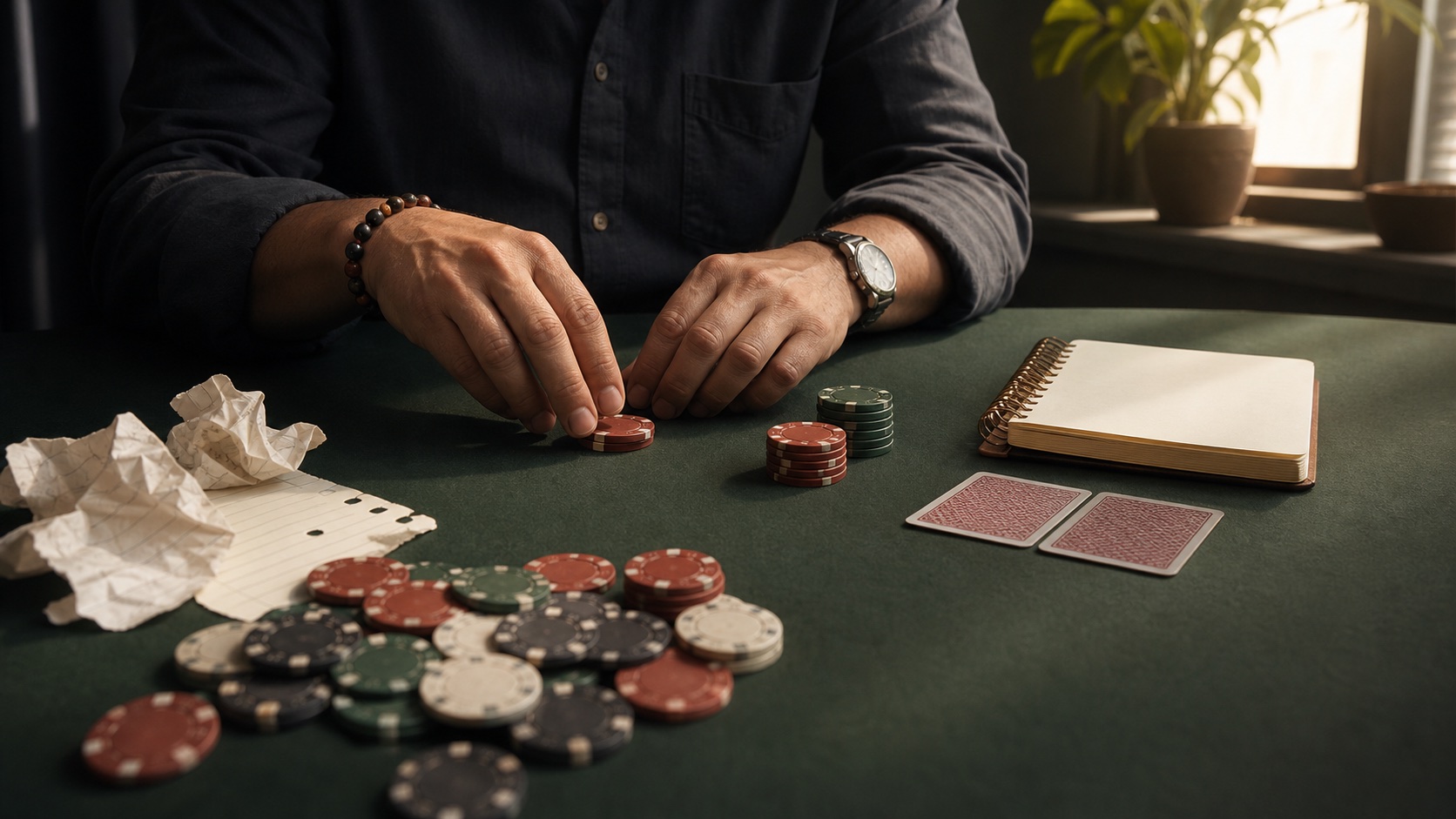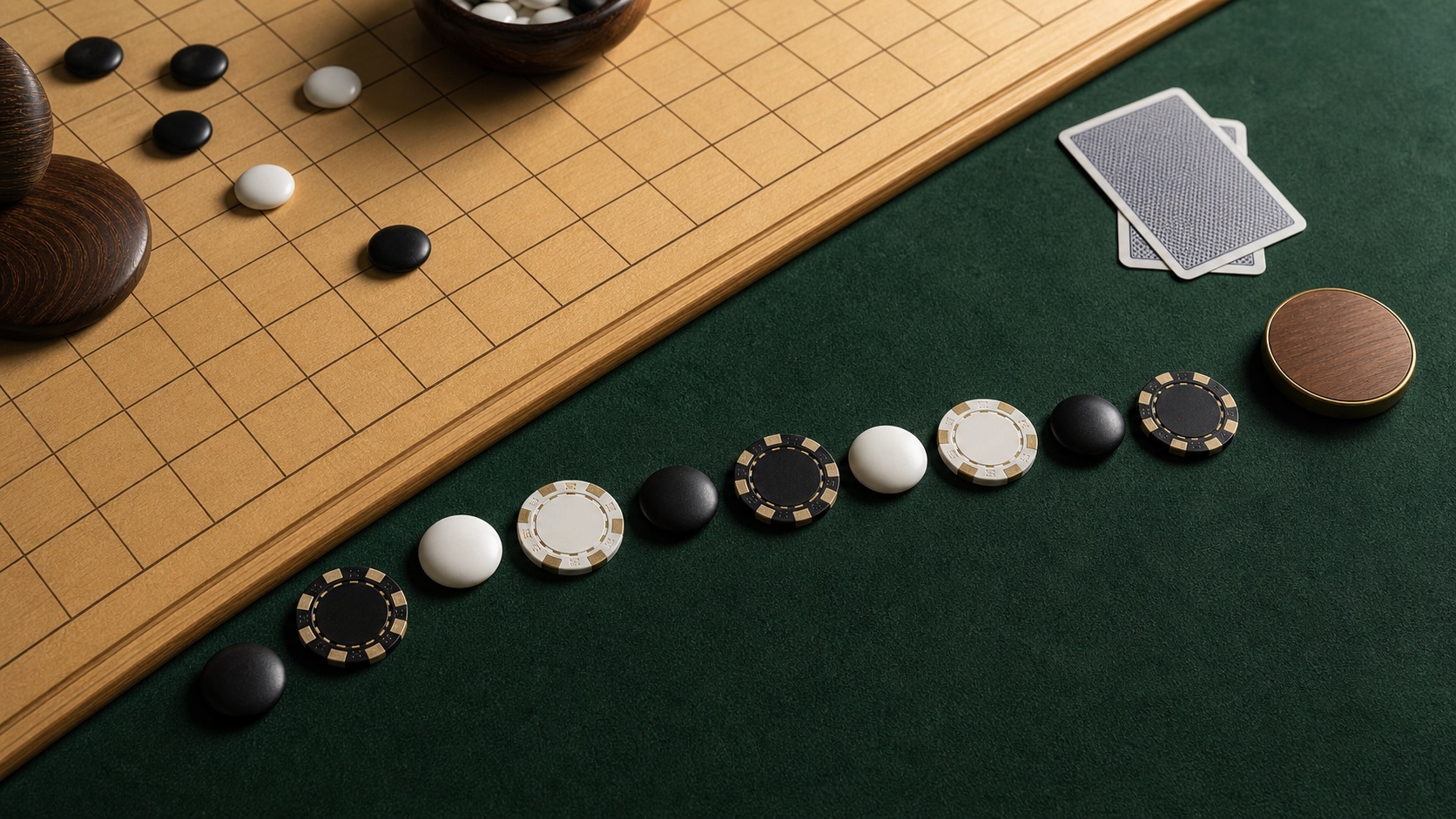
"Go has ten commandments that have been passed down for millennia. So too does Texas Hold'em, with ten disciplines honed over a decade."
Introduction: Two Boards, One Truth
Go, originating in China, has a history spanning over four thousand years.
Texas Hold'em, originating in Texas, has a history of just over a century.
These two seemingly unrelated games converge at the highest level—they are both imperfect information games, seeking optimal solutions amid uncertainty, requiring a triad of mathematics + psychology + mindset.
In its over seventeen hundred years of documented history, Go has distilled a refined set of ten commandments, attributed to Wang Ji from the Tang Dynasty or Liu Zhongpu from the Song Dynasty. In just forty characters, they encapsulate the core principles of strategic thinking.
These ten commandments align perfectly with the profound disciplines of Texas Hold'em.
This article will map each of these principles to the poker table.
Each discipline is a journey of self-cultivation.
1. Do Not Be Greedy for Victory
Those who are greedy for victory will surely fail; those who are not greedy will win over the long term.
The first and most fundamental principle of Go: Do not be greedy for victory.
What does it mean to be greedy for victory?
- Going all-in knowing the EV is negative because "I must win this hand."
- Increasing the bet size after consecutive losses, hoping to turn things around in one hand.
- Flopping top pair and going all-in to maximize value, unaware that the opponent may have a stronger hand.
Go master Lee Chang-ho understands this principle deeply. His style is known as "half-point victory"—seeking only a slight advantage (half a point) with every move, never chasing big kills or massive corners. He has won 16 world championships and dominated the Go world for over a decade.
Application in No-Limit Hold'em:
| Greedy Player's Behavior | Non-Greedy Player's Behavior |
|---|---|
| Seizing every opportunity to go all-in | Steadily accumulating small +EV |
| Making revenge bets after consecutive losses | Maintaining original rhythm, unaffected by results |
| Going all-in with top pair on the flop | Controlling the pot, allowing opponents to continue investing |
| Chasing double-ups after a win | A win is a win; stop chasing |
True victors are not those who win every hand, but those who consistently make the right decisions over the long term.
Aim for a 51% win rate with each hand; over time, this leads to absolute advantage.
2. Enter the Fray Slowly
Enter the fray slowly; aggression is not courage, and caution is not cowardice.
In Go, "entering the fray" refers to entering the opponent's territory. Recklessly diving in often leads to encirclement.
In No-Limit Hold'em, "entering the fray" means every raise, call, or 3-bet.
What does "slowly" mean?
- It’s not about avoiding aggression, but ensuring every attack has a clear reason.
- Assessing position, stack depth, and opponent ranges before deciding to act.
- Avoiding impulsive calls, measuring performance by the quality of actions rather than frequency.
Application in No-Limit Hold'em:
- Pre-flop raises: Why raise? Is it for value or to steal the pot? What’s the position?
- Continuation bets on the flop: Does the opponent's fold rate support this bet?
- All-in on the river: How many hands in the opponent's range are willing to call?
Impulsive calls are the most expensive tuition for beginners. Every entry by a skilled player is a calculated choice.
3. Attack While Guarding
Attack when necessary, defend with rigor. A balanced approach is the best strategy.
In Go, while attacking your opponent, you must also guard against your own weaknesses. Advancing alone often leads to harm.
In Texas Hold'em, this principle has two dimensions:
Dimension One: Don’t Forget Defense While Attacking
When you bet, raise, or bluff, always ask yourself:
- What could my opponent's possible responses be?
- If they call or raise, can I handle it?
- Am I revealing too much information about my hand strength?
Dimension Two: Don’t Forget Counterattack Opportunities While Defending
When you check, call, or fold, also consider:
- Is there a low-cost opportunity for a counterattack?
- Is my opponent using weakness to lure me into folding?
A Classic Example of the Opposite:
You hit top pair on the turn, and your opponent bets. You worry they might have a stronger hand and check-call. The river brings a blank, they bet again, and you fold—when in fact, you were ahead 60% of the time.
The Core of Attack While Guarding: With every decision, consider both the offensive gains and the defensive options.
4. Sacrifice for Advantage
To gain, one must be willing to give up. Sacrificing pieces is essential for the overall game.
In Go, "sacrificing pieces" is done to gain influence, set up, or create eyes. Sacrificing a part for overall advantage.
In Texas Hold'em, "sacrificing" can take several forms:
Form One: Voluntary Fold
Knowing you’re behind, you decisively fold. Don’t pay just to "see" the last card.
Form Two: Strategic Pot Sacrifice
To preserve your chips and maintain your image, you may choose to give up a pot at a crucial moment for the chance of greater opportunities later.
Form Three: Move On After a Bad Beat
After losing a big pot, don’t chase, complain, or make revenge raises. Accept that hand is dead and focus on the next one.
The Most Common Mistake:
"I’ve already invested so much; isn’t folding a loss?"
This is known as the "sunk cost fallacy." The chips you’ve already put in are irrelevant to the EV of your current decision.
A true player always asks: What has the highest EV for this hand now? Call? Fold?
5. Sacrifice the Small for the Big
Small gains can be deceiving; the big picture determines the outcome.
In Go, players may sacrifice small advantages in the corners to create a large dragon or secure significant territory.
In Texas Hold'em, the principle of "sacrifice the small for the big" manifests in several ways:
Aspect One: Single Hand vs. Overall Strategy
Giving up potential profit in a hand (for example, check-calling with a strong hand instead of making a value bet) to maintain consistency in your overall strategy, making it difficult for opponents to read your hand.
Aspect Two: Short-term vs. Long-term
Forfeiting a small profit in a particular hand to uphold a long-term +EV image, encouraging opponents to pay off when you actually have the nuts.
Aspect Three: Emotion vs. System
Letting go of the obsession with "I must win this hand" and choosing to execute your systematic decision-making—even if it seems "incorrect" for that particular hand.
The Principle is Universal:
Go masters are willing to incur minor losses in the corners to maintain an advantage in the overall configuration. Poker experts are willing to forfeit small pots to preserve their strategic advantage.
6. Discard in Times of Danger
Those who know when to advance and retreat are brave; those who cling to remnants are foolish.
In Go, if a group of stones is surrounded and doomed, struggling to save them only leads to greater losses. A skilled player will decisively abandon them and shift focus to other areas.
In Texas Hold'em, "danger" signals can include:
Signal One: Insufficient Odds
The pot odds do not support a call, and the probability of hitting your hand is lower than the required odds. Continuing to invest is akin to "buying a lottery ticket"—you might win in the short term, but you'll inevitably lose in the long run.
Signal Two: Crumbling Image
Your opponents have read your range as very narrow, or you've been on the receiving end of consecutive bad beats, shaking your mindset. Continuing to play will only allow emotions to take over your decision-making.
Signal Three: Financial Red Line
You've reached your predetermined stop-loss threshold. Continuing to play will only harm your bankroll and mental state.
The Core of Discarding in Times of Danger:
Stopping losses is not admitting defeat; it's about preserving your capital to fight another day. The greatest courage lies not in sticking it out in every hand, but in knowing when to walk away.
7. Be Cautious, Not Hasty
Quick is slow, slow is quick. Thoughtful consideration is the right path.
In Go, "haste" refers to actions that are rash, hurried, and unthoughtful. What seems like a quick decision is, in fact, the slowest way to progress.
In poker, "haste" is everywhere:
- Rushed raises on the flop: Failing to assess opponents' ranges, pot odds, and the complexities of future streets.
- Quick decisions while on tilt: Emotion-driven, without thinking.
- Acting immediately on "obvious opportunities": Not double-checking if it’s truly +EV.
True speed comes from thoughtful action.
A skilled player's decisions may appear slow because they have already considered all possibilities in their minds:
- What hands could my opponent have?
- If he calls, what will I do on the turn?
- If he raises, can I continue?
- What is the EV of this decision?
This is the true meaning of "Be Cautious, Not Hasty": Seek not speed, but correctness.
8. Actions Must Correspond
One move affects all. A coordinated approach leads to a grand strategy.
In Go, every move is related to the overall layout. When a piece is placed, the surrounding influence, eye positions, and external forces all change in response.
In poker, "actions must correspond" is reflected in:
Global Perspective
Decisions in a hand cannot be viewed in isolation. Consider:
- What will my image be after this hand?
- Did my recent action reveal my range?
- How will my opponents respond in the next few hands?
Image Interaction
Every hand you play at the table builds your "image." Your image determines how opponents treat you.
- If you play very tight, opponents will give you more credit (making it easier to bluff you).
- If you play very loose, opponents will tighten their ranges (making it harder for your value hands to get paid).
- If your style is varied, opponents will struggle to read you (this is the ideal state).
Dynamic Adjustment
There is no "one-size-fits-all" strategy in poker. After each action, you must adjust based on new information.
The strategy from the previous hand does not equal the strategy for the next hand. True experts are those who continuously adjust based on real-time information.
9. Protect Yourself Against the Strong
In the face of the strong, do not act recklessly. Preserving your strength is the best strategy.
In Go, if your opponent's formation is strong, a rash attack often leads to your own demise. The wise approach is to fortify your position and wait for the right moment to act.
In poker, the signals of a "strong opponent" are clear:
- The opponent plays very tight, only engaging with premium hands.
- The opponent is clearly superior to you in a specific position or style.
- The opponent is currently winning against you while you are not in good form.
Common mistakes when facing the strong:
- Trying to "prove" that you are not worse than your opponent.
- Challenging the strong player with an aggressive strategy.
- Playing too tightly against a strong opponent, which gives them more opportunities to read you.
Correct strategies for protecting yourself against the strong:
- Reduce Intensity: Lower your VPIP and minimize confrontations with strong players.
- Change Tables or Games: If possible, choose tables with weaker opponents.
- Adopt a Learning Mindset: Treat strong players as teachers; observe why they play better than you.
- Stay Calm: Do not let emotions arise from feeling outmatched; continue to execute your system.
True strength lies not in reckless bravado, but in knowing when to advance and when to retreat.
10. Seek Stability in Isolation
Fighting alone will inevitably lead to losses. In times of weakness, seeking stability is paramount.
In Go, if your position is "isolated" (lacking support, no eye, no retreat), forcing a battle is a poor strategy. At this point, you should seek "stability"—aim for a smooth outcome, not for a big win, but rather to avoid significant losses.
In poker, "isolation" means:
- Your chip stack is short, limiting your options.
- You are in a poor position, remaining consistently passive.
- Your hand strength is weak, lacking potential for development.
- Your opponent is strong, putting you at a psychological disadvantage.
Core principles for seeking stability in isolation:
- Lower Expectations: Do not aim to win big pots; instead, focus on "losing less is winning."
- Simplify Decisions: When short-stacked, handle situations in a straightforward manner; avoid overthinking.
- Accept Small Pots: Not every hand needs to be won; sometimes accepting a small pot is a victory.
- Wait for Opportunities: Do not force opportunities when none are present.
Classic application scenario:
When short-stacked (10-15 BB), do not think about "stealing pots" or "doubling up"; instead, focus on the few standard plays with the highest EV: going all-in, folding, or calling all-in with marginal hands.
Accepting "stability" is not failure; it is wisdom. Preserving your strength in weakness allows you to win more in times of advantage.
Conclusion: The Ten Commandments as Ten Practices, the Poker Table as a Dojo
The ten principles of Go are not just technical rules; they embody a mindset.
Similarly, the ten commandments of Texas Hold'em are not merely strategic guidelines; they represent a path of self-cultivation.
Each commandment points to the same core principle:
Do not let your ego take over your decisions.
| Ten Commandments | Ego to Avoid |
|---|---|
| Do not be greedy for victory | Greed: The desire to prove oneself, ignoring probabilities |
| Enter the pot cautiously | Impulsiveness: Jumping into the pot without thought |
| Attack while considering defense | Bias: Focusing solely on offense, neglecting defense |
| Sacrifice pieces to gain an advantage | Attachment: Clinging to every hand, unable to let go |
| Give up small gains for larger ones | Shortsightedness: Focusing only on the immediate, ignoring the bigger picture |
| Abandon when in danger | Stubbornness: Refusing to concede, holding on too tightly |
| Be cautious and avoid haste | Urgency: Making quick decisions driven by emotion |
| Actions must correspond | Isolation: Focusing only on a single hand, ignoring the overall dynamics |
| Protect yourself against the strong | Arrogance: Disregarding stronger players, forcing confrontation |
| Seek harmony in isolation | Greed: Seeking a big win while in a weak position, failing to yield |
The essence of the ten commandments: Let go of your attachments and go with the flow.
"Chess is like life, and life is like chess.
The ten commandments are not constraints; they are the starting point of freedom."
Next Steps for Reading
- Downswings are the Best Training Ground
- The Zen Mind at the Poker Table: Encountering Texas Hold'em with Beginner's Mind
- Not Being Greedy is Winning: How to Transition from Five Poisons to Five Blessings
- Detailed Explanation of the Five Poisons, Five Blessings, and Five Elements Cultivation System
The Poker Table is a Dojo · The Ten Commandments are Ten Practices